Explore More My Biz Coaches Content
The Biz Coach Show
The Podcast of My Biz Coaches
Get weekly educational videos to help you learn how to scale your business, achieve your goals and experience success in all aspects of your life. Stream it on YouTube, Spotify and Apple Podcasts.
Biz Coach Insider
A Weekly Newsletter by Eric T. Whitmoyer
My Biz Coaches
Weekly dedicated insights for entrepreneurs and business leaders committed to growth, strategy, and mastery.

Blogs
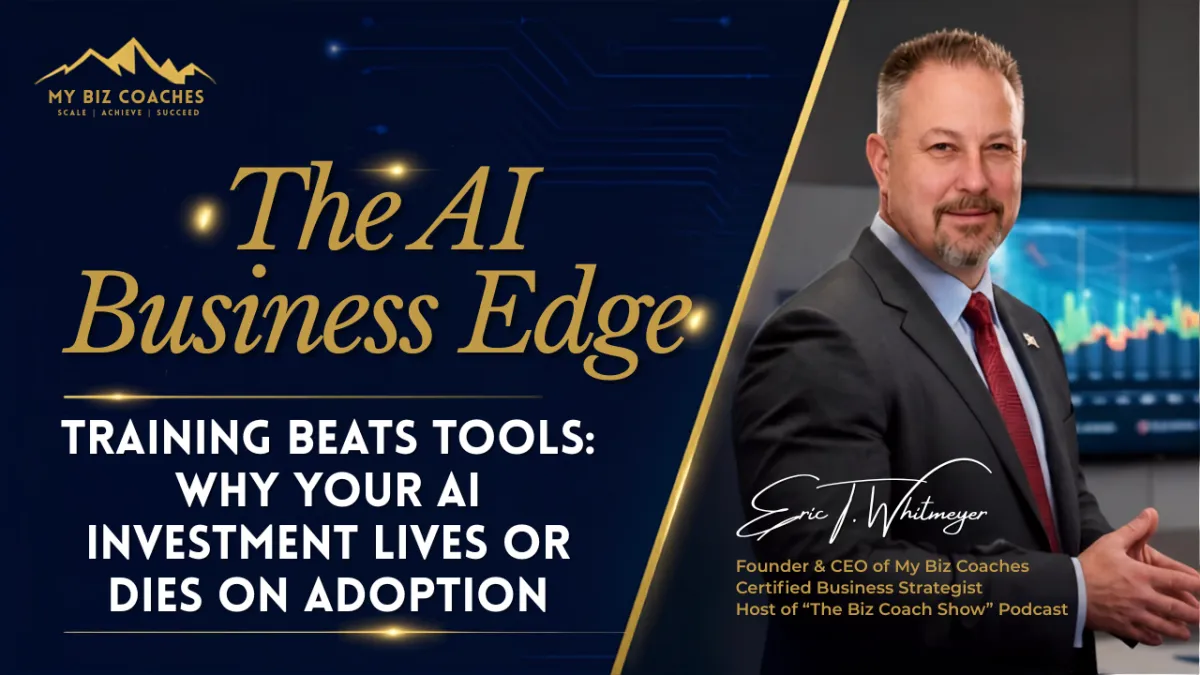
Training Beats Tools: Why Your AI Investment Lives or Dies on Adoption
Years ago, when I was building out leadership at scale in wireless retail, I had a choice to make. I could run a sales training program; teach the reps how to hit the pitch, close the upsell, work the register faster. Or I could build something bigger: A full leadership development program that trained store managers and supervisors how to lead, coach, and hold their own teams accountable.
I built the leadership program. It changed everything. Sales training taught people to do a task. Leadership training taught people to run the store without me standing in it. One of those scales. The other one doesn't.
For the last few years, I've been watching business owners make the same small choice right now, except the tool has changed from a POS system to an AI platform. They buy the subscription, forward the login link to the team in a Slack message, and assume everyone will "figure it out." Some of them do. Most of them open it twice, get a mediocre result on try number one, and quietly go back to doing it the old way. Ninety days later, the owner is still paying for a tool nobody opens.
Buying the tool is 10% of the job. Training your team to actually use it, correctly, consistently, is the other 90%. Almost nobody budgets time or money for that second part, and it's the only part that determines whether the investment pays off.
What the Data Says
This isn't a hunch. MIT researchers tracking enterprise AI deployments found that roughly 95% of generative AI pilots fail to produce a measurable return, and the report's conclusion wasn't that the models are bad; it was that most failures trace back to how the tools were rolled out, not what they can do.
Harvard Business Review's 2026 workforce research backs that up from the other direction: 88% of companies say they use AI regularly, but only about 5% of employees are actually using it in a way that meaningfully changes their output. Everyone technically "has" the tool. Almost nobody was shown how to get real value out of it.
PwC's numbers are the ones that should get an owner's attention: Only 10 to 12% of companies report a tangible revenue benefit from their AI spend, while 56% say they got essentially nothing out of it. Same tools, wildly different outcomes, and the difference isn't the software.
Fyxer's research on workplace AI adoption puts a number on the training gap directly. Two out of three employees who use AI tools their employer supplied describe them as "partial, ineffective, or insufficient"; not because the tool is broken, but because nobody taught them how to run it well. And BCG found the pattern that matters most for planning a rollout: regular, confident AI usage jumps sharply once a worker gets at least five hours of focused training with someone available to coach them through real use cases. Right now, only about a third of employees say they've gotten training anywhere close to that.
Put it together: The businesses seeing a return aren't the ones with the best AI tool. They're the ones that treated the rollout like an actual training program instead of a group email with a login link.
Where This Hits Hardest
This shows up hardest at the Operator phase moving into Architect ($500K–$3M). That's the exact stretch where an owner starts handing off execution for real, not because they want to micromanage the tool less, but because the whole point of that phase is building a team that can run without the owner standing over every shoulder. If the AI rollout is just a login link, you haven't handed anything off. You've added one more thing that quietly depends on you to actually work.
This sits squarely at the intersection of two of the 7 Core Competencies: People Management and Operational Excellence. People Management, because adoption is a leadership problem before it's a technology problem; someone has to own it, coach it, and hold the team to using it. Operational Excellence, because an AI tool with no adoption plan isn't a process improvement. It's an unused line item.
The 90% Rollout: Four Things That Actually Drive Adoption
1. Name an owner. Someone specific - not "the team" - is responsible for making sure the tool gets used well. No owner means no accountability, and no accountability means the tool dies quietly within a month.
2. Train on your use cases, not the vendor's demo. A generic onboarding video shows the tool doing something impressive and unrelated to your business. Show your team the three or four things they'll actually use it for every week, using your real data and your real workflows.
3. Build in a feedback loop, not a one-time session. One hour of training in week one and nothing after is exactly the pattern behind that 95% failure number. Schedule a 15-minute check-in every week for the first month: what's working, what's confusing, what got abandoned.
4. Measure usage, not licenses. "We bought the tool for the whole team" tells you nothing. Track who actually opened it this week and what they used it for. That number is your real adoption rate, and it's the only one that predicts ROI.
Do This
✓ Assign one person to own the rollout before you buy the tool, not after.
✓ Train your team on your specific use cases, using your own data, not the vendor's generic demo.
✓ Schedule short, recurring check-ins for the first month — adoption is built in week three, not week one.
✓ Track actual weekly usage, not seat count, as your real measure of ROI.
✓ Treat the training budget as part of the tool's cost, not an optional add-on.
Don't Do This
✗ Don't forward a login link and call that a rollout.
✗ Don't assume a "user-friendly" interface replaces training — intuitive still means untrained the first ten times.
✗ Don't buy a second AI tool to fix a problem the first one never got trained into.
✗ Don't measure success by whether you bought the tool. Measure it by whether anyone still opens it in month three.
✗ Don't skip the follow-up session. The tools that get abandoned almost always got abandoned quietly, without anyone flagging it.
The Bottom Line
95% of AI pilots fail to show a return, and the research keeps landing on the same root cause: not the model, not the price tag, the rollout. Buying the tool is the easy 10%. Training your people to actually run it, and staying on them long enough for it to become a habit, is the 90% that determines whether you got an asset or a shelf-ware subscription. The owners pulling ahead this year aren't the ones with the most AI tools. They're the ones who trained their team like the tool actually mattered.
Reflective question: Of the AI tools you're currently paying for, how many has your team actually opened this week, and would you know the answer if I asked you right now?
To Your Success,
Eric T. Whitmoyer, Business Growth Strategist
Founder & CEO at MyBizCoaches.com
Host of The Biz Coach Show
From Startup to Exit, We're There for Your Biggest Decisions
P.S. If you're serious about taking your business to the next level, then you may find value in getting a copy of our 2026 Business Survival Guide, full of strategies, tactics, and solutions to help move your business forward faster this year.
👉 Download the Guide Here
Because the difference between ordinary and extraordinary isn't luck; it's the information you act on.
Consider becoming a Certified My Biz Coach – Learn More HERE.

Empowered Growth With Coaching
Trusted by owners who scaled to $10M and beyond.
© 2026 - All Rights Reserved