
Explore More My Biz Coaches Content
The Biz Coach Show
The Podcast of My Biz Coaches
Get weekly educational videos to help you learn how to scale your business, achieve your goals and experience success in all aspects of your life. Stream it on YouTube, Spotify and Apple Podcasts.
Biz Coach Insider
A Weekly Newsletter by Eric T. Whitmoyer
My Biz Coaches
Weekly dedicated insights for entrepreneurs and business leaders committed to growth, strategy, and mastery.

PARTNER WITH US
Partnership Opportunities
Put your brand in front of business owners, coaches, and leaders who are actively investing in growth. We partner with brands through The Biz Coach Show podcast and the Biz Coach Insider newsletter.
The Biz Coach Show
Weekly episodes on YouTube, Spotify, and Apple Podcasts focused on scaling, leadership, and growth.
- Sponsored episode segments
- Brand and founder interviews
- Product features and walkthroughs
Biz Coach Insider
Our weekly newsletter delivering practical strategy to entrepreneurs and business leaders.
- Featured articles and reviews
- Sponsored placements
- Cross-promotion on LinkedIn
Affiliate and referral partnerships: we recommend tools our clients use in AI, marketing, finance, and operations. Revenue share and bundled packages available.
Blogs

AI Pricing for Small Business: Protect Your Holiday Margin
Most Owners Raise Prices by Gut Feel. Use AI to Protect Your Holiday Margin Instead
The supplier invoice goes up. They pick a number that feels safe. Then they hope.
Hope is not a margin plan. This year it's an expensive one.
Here's the short answer. AI pricing for small business is not about letting a bot set your prices. It's about using a free AI assistant to do the math most owners skip. Rank every product by margin. Test a 3%, 5%, and 8% increase on paper. Find the items quietly losing money. You still make the call. AI just shows you the numbers first.
Why are small businesses raising prices this holiday season?
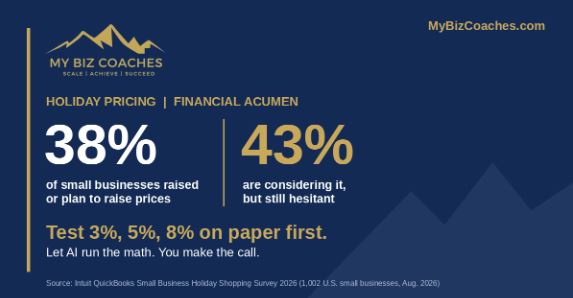
Intuit QuickBooks surveyed 1,002 U.S. small businesses in August 2026. 38% have already raised prices or plan to this season. Another 43% are considering it but still hesitant.
48% bought extra inventory ahead of tariffs. Of those, 36% say they're already restocking at noticeably higher prices.
And 76% expect to make more money this holiday season than last year.
Put those together. Most owners expect a bigger season, and a big chunk of them still don't know what to charge. That's how a business has a record December in sales and a thin January in the bank account.
Where does pricing fit in your business?
This is Financial Acumen, one of the 7 Core Competencies we coach at My Biz Coaches. And it looks different depending on where you sit in the 8 Phases of Scale.
In the Operator phase ($250K to $500K), pricing usually lives in the owner's head. You know your products. You know your customers. What you don't have is a report that tells you which items still make money after your costs went up.
By the Optimizer phase ($3M to $10M), pricing can't live in one person's head. Margin is protected by a system: a monthly review, a floor price on every item, and a trigger when cost moves.
The gap between those two phases is mostly a habit. AI makes that habit cheap enough to start this week.
What fixing broken stores taught me about best sellers
For 30 years I was the guy sent in to fix underperforming stores and markets. The first report I asked for was never sales. It was margin by item.
In one wireless store I took over, the team was proud of its top-selling accessory bundle. It moved more units than anything in the building. When we lined up the real costs, including the free install reps threw in to close the sale and the returns that came back, that bundle was making almost nothing. Some months it lost money.
The store was busy and broke at the same time.
Nobody did anything wrong on purpose. Somebody priced it years earlier and nobody looked again. We repriced it and dropped the freebie. Units dipped a little. Gross profit went up.
That review took my team a weekend with printouts and a calculator. Today you can do the first pass in about twenty minutes.
Try This Today: find your margin leaks with AI in under an hour
1️⃣ Export last quarter's sales by item. QuickBooks, Square, Shopify, and Clover all have a sales-by-item or product sales report. You need item name, units sold, revenue, and cost per unit. Delete customer names before you go any further.
2️⃣ Paste it into Claude or ChatGPT with this prompt: "Rank these items by gross margin percentage and by total gross profit dollars. Flag the bottom 10 by margin. Show your math in a table."
3️⃣ Update your costs. For anything you've restocked at a higher price, swap the old cost for your newest invoice cost. Then ask: "Re-run the ranking with these new costs. Which items dropped the most?"
4️⃣ Test on paper. Ask: "For the bottom 10, show the margin at a 3%, 5%, and 8% price increase. Also show how many fewer units I could sell at each increase and still make the same gross profit dollars."
5️⃣ Check and decide. Spot-check three rows with a calculator. Then sort the list into three piles: reprice, bundle, or stop reordering.
✅ Price your next order on what it will cost you to restock, not what you paid last summer.
❌ Don't let AI pick the final price. It doesn't know your customers, the competitor down the street, or which item brings people through the door.
Run a service business? Same method. Export invoices by service or package. Use labor hours times your loaded hourly cost, plus materials, as the cost. The usual leak is the package you priced two years ago that now takes an extra hour to deliver.
Is AI pricing worth it for a small business?
Here's a simple example. A product costs you $12 and sells for $20. That's a 40% margin. Your restock cost rises 10% to $13.20. Same $20 price, and your margin drops to 34%.
Now test it on paper:
• 3% increase ($20.60): 35.9% margin
• 5% increase ($21.00): 37.1% margin
• 8% increase ($21.60): 38.9% margin
Even 8% doesn't get you back. You'd need $22.00. Gut feel misses that every time.
Small moves add up. McKinsey's well-known pricing research, published in Harvard Business Review, found that a 1% price improvement with no loss of volume raised operating profit by about 11% across the companies studied. Price is the strongest profit lever most small businesses never touch on purpose.
A few things to watch:
✳️ AI can get math wrong. That's why step 5 exists.
✳️ Protect your data. Strip customer names and use a business plan or privacy settings that keep your data out of model training.
✳️ This is a method, not pricing advice for your business. Run final changes past your accountant or bookkeeper, especially if tariffs are muddying your true cost.
AI is a tool. You and your team are still the limiting factor. Feed it bad cost data and it will rank the wrong items with total confidence.
➡️ Coaches and consultants: this is one of the best first AI exercises for an Operator-phase client. It's fast, it's private, and the result is money they can see.
Reflective Question
If I asked you to name your three least profitable products or services right now, without looking, how sure are you that you'd get them right?
Quick Answers
Can AI help a small business set prices? Yes, as an analyst, not the decision maker. Tools like Claude or ChatGPT can rank your products by margin and show what a 3%, 5%, or 8% increase does before you change a price tag. The owner still decides, based on customers and competition.
How do I find which products are losing money? Export sales by item with cost per unit, then ask an AI assistant to rank items by gross margin percentage and total gross profit dollars. Update costs to your newest invoice prices first, because old costs hide the leaks. Spot-check the math before acting.
When should a small business stop pricing by gut feel? Usually in the Operator phase ($250K to $500K) of the 8 Phases of Scale, once the product or service list is too long to track in your head. By the Optimizer phase ($3M to $10M), margin reviews should be a monthly system. The Financial Acumen score in the free My Biz Navigator assessment shows where your pricing discipline stands today.
Where to Go From Here
✳️ Find out where your pricing really stands: Take the free My Biz Navigator assessment. Your Financial Acumen score shows whether margin is a strength or a blind spot, in about 5 minutes.
✳️ Free coaching session: Want a second set of eyes on your margin report before the holiday rush? Book a free session and we'll map where AI fits in your numbers.
✳️ Coaches and consultants: Your clients are asking about AI and about prices. Become a Certified My Biz Coach and help them with both.
Sincerely,
Eric T. Whitmoyer, Business Growth Strategist
Founder & CEO at MyBizCoaches.com
Host of The Biz Coach Show
From Startup to Exit, We're There for Your Biggest Decisions
P.S. Curious where your business really stands? My Biz Navigator is a free 5-minute assessment that shows you exactly what's working and what it's quietly costing you.
Take it here → www.MyBizNavigator.com
Because the difference between ordinary and extraordinary isn't luck; it's the information you act on.

Empowered Growth With Coaching
Trusted by owners who scaled to $10M and beyond.
© 2026 - All Rights Reserved