Explore More My Biz Coaches Content
The Biz Coach Show
The Podcast of My Biz Coaches
Get weekly educational videos to help you learn how to scale your business, achieve your goals and experience success in all aspects of your life. Stream it on YouTube, Spotify and Apple Podcasts.
Biz Coach Insider
A Weekly Newsletter by Eric T. Whitmoyer
My Biz Coaches
Weekly dedicated insights for entrepreneurs and business leaders committed to growth, strategy, and mastery.

PARTNER WITH US
Partnership Opportunities
Put your brand in front of business owners, coaches, and leaders who are actively investing in growth. We partner with brands through The Biz Coach Show podcast and the Biz Coach Insider newsletter.
The Biz Coach Show
Weekly episodes on YouTube, Spotify, and Apple Podcasts focused on scaling, leadership, and growth.
- Sponsored episode segments
- Brand and founder interviews
- Product features and walkthroughs
Biz Coach Insider
Our weekly newsletter delivering practical strategy to entrepreneurs and business leaders.
- Featured articles and reviews
- Sponsored placements
- Cross-promotion on LinkedIn
Affiliate and referral partnerships: we recommend tools our clients use in AI, marketing, finance, and operations. Revenue share and bundled packages available.
Blogs
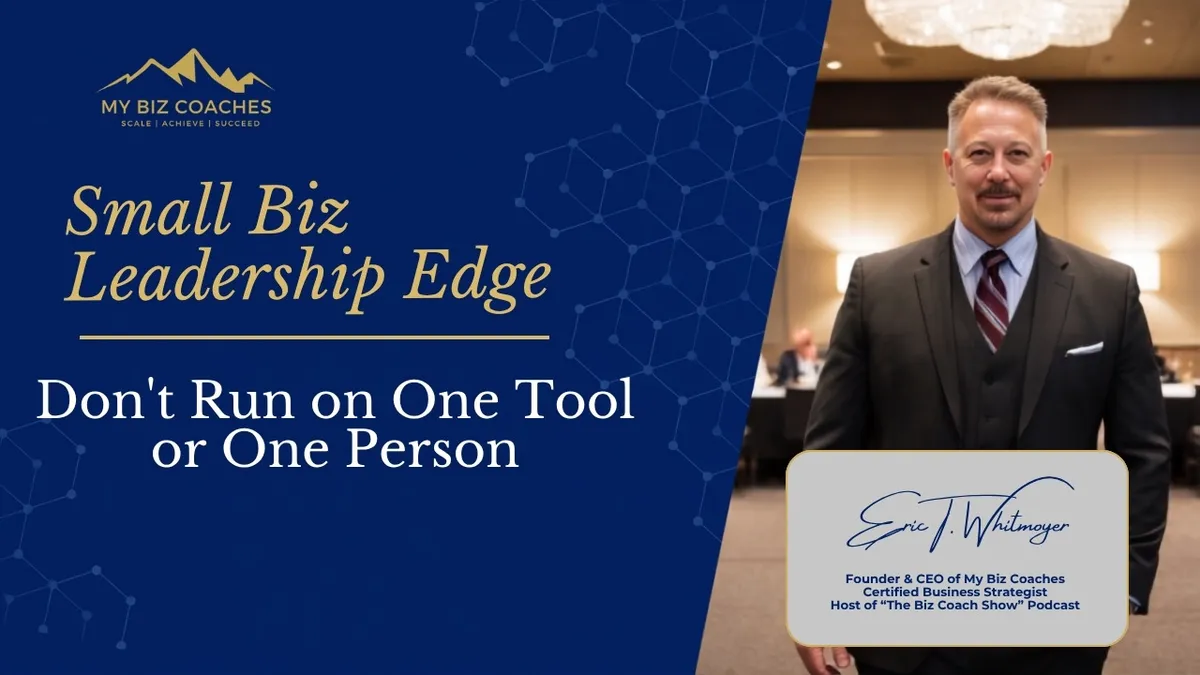
Key Person Risk: Don't Run on One Tool or One Person
"She's been with me nine years. She's not going anywhere."
Maybe not. But she'll get sick, take a vacation or retire someday. And that week, the business will find out everything only she knew.
Here's the quick answer. Key person risk is any tool or person your business can't run without for a week. List them, rank the top three, and write a backup for each. Then tap the experienced talent now on the market, fractionally.
Competency: People Management, with Leadership & Vision
Phase of Scale: Operator ($250K to $500K) to Leader ($500K to $1M)
Where this shows up
Last week, two software companies a lot of small businesses run on announced big cuts. Canva is cutting about 1,271 jobs, roughly 22%. Squarespace is cutting about 19%.
Neither company is going away. But the tools you treat as permanent are run by companies making hard choices too. Features change. Prices move.
The same thing happens with people. Most owners I work with have at least one person who holds the keys: the bookkeeper who knows every login, the ops lead who knows how payroll actually runs, the salesperson with the relationships in her phone.
I learned this lesson in the military. No job belonged to one person. If someone went down, the person next to them knew enough to keep the mission moving, because we trained it before we needed it. [ILLUSTRATIVE: confirm this detail and add one specific from your service]
Small businesses rarely train that way. One person per job, and the owner as everyone's backup.
That's the leadership gap. It's rarely the person who creates the risk. It's the owner who never built the backup.
What the 2026 data confirms
✳️ Canva's growth slowed for the first time in a decade, and it's cutting about 22% of staff, merging teams and moving to broader roles, according to TechCrunch.
✳️ Challenger counts 165,925 tech job cuts through September, up 54%, with AI cited in about 21% of them (via TheStreet).
✳️ Microsoft offered voluntary exits to 60,000+ employees, according to Business Today.
✳️ Gallup puts U.S. engagement at 29% in Q3, the lowest since 2011. Only 46% strongly agree they know what's expected of them, and 37% that someone at work cares about them.
➡️ The takeaway for owners: losing a tool or a person hurts. Finding out nobody else knows what they did hurts more.
The insight: single points of failure are a leadership choice
1️⃣ Audit tools and people on the same list. Write down every tool and every person the business can't run without for a week. For each tool, note who owns the login, where the data lives and how you'd export it. For each person, note what only they know.
2️⃣ Document the five workflows only one person knows. A one-page checklist or a 10-minute screen recording for each. Frame it as protecting them: "I want you to be able to take a real vacation." With only 46% clear on what's expected, written workflows help everyone.
3️⃣ Hire experienced, laid-off pros fractionally. People leaving big tech companies built systems at scale. Ten hours a month from a former operations lead can document your workflows and train your backups, without a big-company salary.
To Do
✅ List every tool and person the business can't run without for a week
✅ Rank the top three by how badly a week without them would hurt
✅ Write a one-page backup plan for each of the top three this week
✅ Make sure at least two people can log in to every critical tool
✅ Ask your key people to record their five "only I know this" workflows
✅ Reach out to one experienced, recently laid-off pro about fractional help
Don't Do
❌ Assume a big vendor will always be there, unchanged
❌ Let one person hold every password
❌ Treat documentation as a sign you don't trust someone
❌ Wait for a resignation to find out what someone knew
❌ Hire full-time when 10 fractional hours a month would solve it
❌ Make yourself the backup for every role
What this looks like as you scale
In the Hustler phase ($100K to $250K), you are the single point of failure. Start writing things down and keep logins in one secure place.
In the Operator phase ($250K to $500K), the risk moves to your first key hires. One resignation can stall a quarter. Build backups while the team is small.
In the Leader phase ($500K to $1M), your managers own the backup plans for their teams. Your job is checking that the plans exist and get practiced.
In the Architect phase ($1M to $3M) and beyond, redundancy lives in the org chart and an annual vendor review.
Coaches face it too. A practice built on one referral source or one platform is on rented land. This Thursday's post looks at what happened to authors who learned that the hard way.
In The CEO's Playbook for Scale, I call People Management the competency that decides whether you grow or just get busier.
Reflective questions
If your most trusted person were out for 30 days starting tomorrow, what would stop first?
Which tool would hurt the most if it doubled its price or changed overnight, and do you have your data out of it?
Quick Answers
What is key person risk in a small business?
Key person risk is the danger that the business stalls when one person, or one tool, isn't available. It usually shows up as one employee who holds the logins, the process knowledge or the customer relationships. The fix is a written backup and a second trained person.
How do I reduce single points of failure in my small business?
List every tool and person you can't run without for a week, rank the top three, and write a one-page backup for each. Most owners feel this in the Operator phase of the 8 Phases of Scale ($250K to $500K), when the first key hires start holding knowledge the owner doesn't.
Should a small business hire laid-off tech workers?
Often, yes, especially fractionally. Experienced people from larger companies can document workflows and train your team in a few hours a month. It's a People Management move that buys depth without a full-time salary.
Your Next Steps
✳️ Become a Certified My Biz Coach: This week's focus. If you're an experienced leader now between roles, your next move could be a business coaching practice built on what you already know.
✳️ 2026 Business Survival Guide: The free guide to keeping the business running when one person or tool goes down. Get it here → [SURVIVAL GUIDE LINK]
✳️ Free coaching session: Want help finding your top three risks? Book a free session with a My Biz Coaches business coach and leave with your first backup plan.
Sincerely,
Eric T. Whitmoyer, Business Growth Strategist
Founder & CEO at MyBizCoaches.com
Host of The Biz Coach Show
From Startup to Exit, We're There for Your Biggest Decisions
P.S. Curious where your business really stands? My Biz Navigator is a free 5-minute assessment that shows you exactly what's working and what it's quietly costing you.
Take it here → www.MyBizNavigator.com
Because the difference between ordinary and extraordinary isn't luck; it's the information you act on.

Empowered Growth With Coaching
Trusted by owners who scaled to $10M and beyond.
© 2026 - All Rights Reserved