
Explore More My Biz Coaches Content
The Biz Coach Show
The Podcast of My Biz Coaches
Get weekly educational videos to help you learn how to scale your business, achieve your goals and experience success in all aspects of your life. Stream it on YouTube, Spotify and Apple Podcasts.
Biz Coach Insider
A Weekly Newsletter by Eric T. Whitmoyer
My Biz Coaches
Weekly dedicated insights for entrepreneurs and business leaders committed to growth, strategy, and mastery.

Blogs
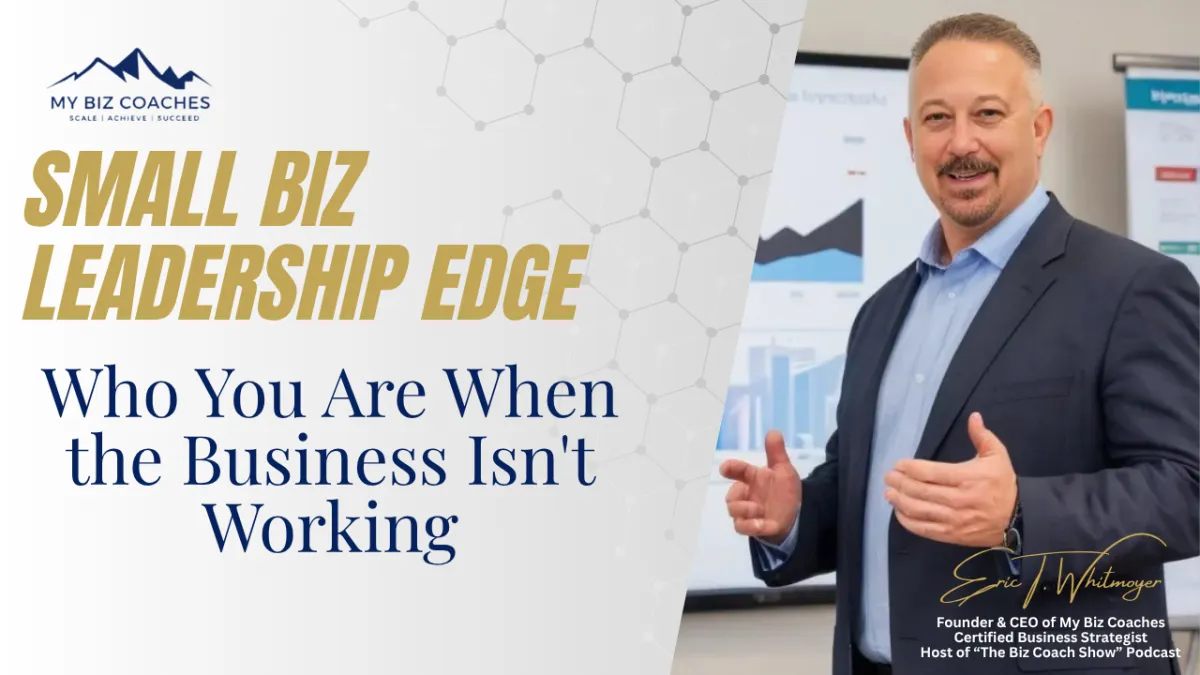
Who You Are When the Business Isn't Working
Why founder identity fusion makes you wait too long, work too hard, and refuse to delegate and how to separate your self-worth from this quarter's numbers.
Small Biz Leaders Edge · Competency: Leadership & Vision · Phase: Any
The short answer: When your identity is fused to your company, every business problem becomes a personal verdict. That's why owners hold onto dying offers, out-work problems they should out-think, and can't hand off work they've already outgrown. The fix isn't detachment or "balance." It's building a second scoreboard — a clear, written definition of who you are that a bad quarter can't touch.
The 2 a.m. math
You know the math I mean.
It's late. Everyone's asleep. You're running the same numbers you ran at 4 p.m., hoping they landed somewhere different. Revenue is soft. A key person gave notice. The client you thought was a lock went quiet.
And somewhere in that loop, the question stops being what's wrong with the business and quietly becomes what's wrong with me.
I've coached hundreds of owners through that exact hour. I've also sat in it myself. And here's what I've learned: that shift — from the business has a problem to I am the problem — isn't a character flaw. It's the predictable result of how you built the thing.
You didn't just start a company. You put your name on it, your savings in it, your reputation behind it. You told your family it would work. You became "the guy who owns the shop" at every school function for eleven years.
Of course it's fused to you. You welded it on yourself, one decision at a time.
The problem is that a weld holds in both directions.
What is founder identity fusion?
Founder identity fusion is the condition where a business owner's sense of personal worth is functionally indistinguishable from the performance of their company. When revenue is up, they feel like a good person. When revenue is down, they feel like a failure — not a leader facing a solvable problem, but a fraud about to be found out.
It isn't ego. Most fused owners are humble to a fault. It's leverage — your entire self-esteem is collateralized by one asset you can't fully control.
And it shows up in three expensive, measurable ways.
The three costs nobody puts on the P&L
1. You wait too long.
Killing the product, firing the underperformer, exiting the business — each one requires admitting something you built isn't working. If the business is you, then shutting down a service line feels like amputating part of yourself. So you wait. You give it another quarter. You "see how Q4 goes."
I work with owners on exit planning, and this is the single most expensive pattern I see. The best time to sell is usually 18 months before an owner is emotionally willing to consider it. The delay isn't strategic. It's identity.
2. You work too hard at the wrong altitude.
When effort is how you prove you're worthy, you will always choose the harder path. You'll answer the email at 11 p.m. because responsive is part of your self-image. You'll do the install yourself because nobody cares like I do.
Hours become evidence. And evidence-gathering is not a strategy. Owners in this loop are usually working at $25/hour on a business that needs a $500/hour decision.
3. You can't delegate — because delegation feels like disappearing.
This is the one owners rarely say out loud. If the business runs beautifully without you, what exactly are you?
So you keep a few things. You stay on the approval chain. You "just want to see it before it goes out." And your company stalls in the exact phase it's in, because the bottleneck isn't capacity — it's the quiet fear that being unnecessary is the same as being worthless.
It isn't. But nothing in your wiring is going to tell you that on its own.
A business that needs you is a job. A business that chooses you is an asset.
Why this is a Leadership & Vision problem, not a mindset problem
Of the 7 Core Competencies, this lives squarely in Leadership & Vision — and it's the one competency that silently caps the other six.
Financial Acumen doesn't fail because you can't read a P&L. It fails because you can't look at it clearly when it feels like a report card on your soul. Operational Excellence doesn't fail from lack of systems. It fails because systems make you replaceable, and some part of you is voting against that.
This is also why it's phase-agnostic across the 8 Phases of Scale. I see it in a Phase 2 owner who won't stop doing the work, and in a Phase 7 owner with 60 employees who still approves every invoice. The business changed size. The weld didn't.
How to separate your self-worth from this quarter's numbers
Not detachment. You're supposed to care — that's why you're good at this. The goal is differentiation: caring enormously about the outcome while knowing you are not the outcome.
Five things that actually work, in the order I'd run them.
1. Write the second scoreboard.
One page. Not affirmations — evidence. List who you are in terms a bad quarter can't revoke: what you're skilled at, what you've survived, who depends on you and why, what you've built for people who don't appear on your customer list. Most owners have never written this down, which is exactly why revenue fills the vacuum. Read it on the bad weeks. It will feel ridiculous. Do it anyway.
2. Change the grammar.
Stop saying "I had a terrible month." Start saying "The business had a terrible month." It sounds like semantics. It isn't. Language is where the weld either holds or loosens. Run it for 30 days and notice how differently you make decisions when the subject of the sentence changes.
3. Run the client test.
Take the decision you've been avoiding for 90 days. Write it out as if a client brought it to you. Then answer it as their coach.
You already know the answer. You've known for a while. The clarity gap isn't knowledge — it's that you're the only client you're not allowed to be honest with.
4. Delegate one thing you're known for.
Not one thing you hate. Owners delegate what they hate all the time and it changes nothing. Pick something that's part of your reputation — the discovery call, the final walkthrough, the proposal — and hand it to someone who will do it 80% as well.
Watching the business stay standing while someone else does the thing you're "known for" is worth more than any book on the subject. That's the rep that builds the muscle.
5. Build one identity outside the P&L.
One role, one room, one practice where nobody knows or cares what your revenue is. Coach the team. Take the class. Serve on the board. This is not a work-life-balance suggestion — it's risk management on your single most concentrated asset.
What resilience actually looks like
We've romanticized founder resilience into grinding. It isn't.
Resilience is the capacity to absorb a bad result without it rewriting who you think you are. That's it. That's the whole thing. Grinding is what you do instead, when you don't have it.
The most durable owners I know aren't the ones who never have a bad quarter. They're the ones who can look at a bad quarter, say "that was a bad quarter," make three decisions, and sleep. Not because they care less. Because they've done the work of knowing where they end and the company begins.
That line is the most valuable asset you'll ever build — and it's the only one that doesn't show up in the valuation.
If the business isn't working right now, that's information. It is not a verdict. And the distance between those two words is where the next version of your company gets built.
Find out where the weld is holding you back
If this landed, don't guess at where to start. Take the free My Biz Navigator assessment at MyBizNavigator.com; it scores you across all 7 Core Competencies (starting with Leadership & Vision), identifies exactly which of the 8 Phases of Scale you're in right now, and shows you the specific constraint holding your business at its current ceiling.
It takes a few minutes. Most owners find that what they've been grinding on isn't what's actually capping them.
To Your Success,
Eric T. Whitmoyer, Business Growth Strategist
Founder & CEO at MyBizCoaches.com
Host of The Biz Coach Show
From Startup to Exit, We're There for Your Biggest Decisions
P.S. If you're serious about taking your business to the next level, then you may find value in getting a copy of our 2026 Business Survival Guide — full of strategies, tactics, and solutions to help move your business forward faster this year.
Because the difference between ordinary and extraordinary isn't luck; it's the information you act on.
Consider becoming a Certified My Biz Coach – Learn More HERE.

Empowered Growth With Coaching
Trusted by owners who scaled to $10M and beyond.
© 2026 - All Rights Reserved