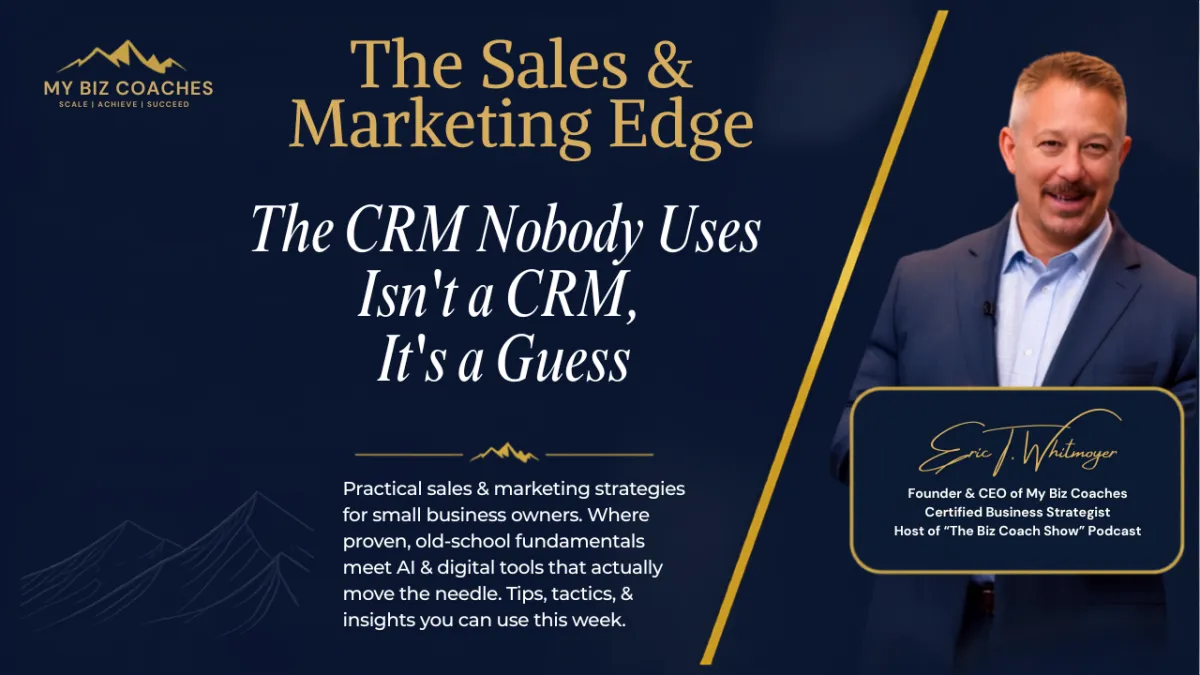
The CRM Nobody Uses Isn't a CRM, It's a Guess
Your CRM has 400 contacts. Maybe 40 are current.
I sat in a client's office in April, an HVAC company doing about $420,000 a year, and asked to see his pipeline. He opened a CRM his son-in-law had talked him into buying eighteen months earlier. Fourteen deals showed "open." He scrolled through them with me and confirmed, one by one, that eleven were already closed, dead, or he genuinely couldn't remember the last conversation. He'd been running his real pipeline in his head and a legal pad on his truck seat. The software was decoration.
That's not a tech problem. That's a forecasting problem wearing a tech costume.
Where this breaks: Operator to Leader
In the Creator phase, $0 to $100K, a notebook works fine. You have twelve customers, and you remember them all. Nobody needs a CRM to remember twelve people.
Somewhere in the Operator phase, $250K to $500K, that stops working. You've got a few hundred contacts, a handful of reps or yourself plus one salesperson, and deals moving fast enough that memory starts dropping things. By the Leader phase, $500K to $1M, you usually have outside sales help, more inbound noise, and a forecast that matters because payroll and inventory decisions depend on it. This is exactly when most owners buy a CRM, get excited for six weeks, and quietly stop opening it before day 90.
Here's why. They buy the CRM to solve a lead problem. But the CRM's real job is solving a memory problem, a follow-up problem, and a forecasting problem; three things that were never broken in the owner's head because the owner was the whole sales team. The moment someone else needs to see the pipeline, or the owner needs a real number to plan around instead of a gut feeling, personal memory stops being a viable system. Most businesses don't notice the system failed. They notice the CRM failed, and they blame the software.
What actually happens in 90 days
Week one, everyone's excited. Fields get filled in. By week three, the owner is back on the road, the rep is back on the phone, and updating records feels like paperwork instead of selling. By week eight, half the deals in the system are stale. By day 90, the CRM has become a graveyard nobody trusts, so nobody looks at it, so it never gets fixed. That's the abandonment cycle, and I've watched it happen with almost identical timing across a wide range of industries.
According to Demandsage's compiled CRM research, only 40% of businesses hit a 90% adoption rate on their CRM, meaning most companies are running on partial, unreliable data from day one. And 43% of CRM users use fewer than half the features they're paying for, per Kylas data cited in that same research. You're not just losing forecasting accuracy. You're paying monthly for software you're using at less than half capacity.
A CRM full of guesses is worse than no CRM at all, because it looks like data. Owners make real decisions off it: How many reps to hire, what inventory to order, what the next quarter looks like. A guess dressed up as a report is how you overhire in a slow quarter or underbuy right before a busy one.
What fixes it (it's not more training)
✅ Pick three fields that actually predict revenue: Next step, next date, dollar value. Nothing else is mandatory.
✅ Build the update into the existing workflow. If your team already does a Friday call, the CRM update happens live on that call, not as separate homework.
✅ Tie CRM hygiene to something the owner actually reviews weekly. What gets inspected gets respected. What doesn't, gets abandoned by day 90 like everything else.
✅ Assign one person as the data owner, even in a five-person company. Shared responsibility for CRM hygiene means no one is responsible.
❌ Don't buy the CRM with the most features. Buy the one your least tech-comfortable rep will actually open.
❌ Don't roll it out and walk away. The tool doesn't fail in month one. It fails in month three, when nobody's watching anymore.
❌ Don't confuse activity for accuracy. A CRM full of updated notes and wrong dollar values still produces a forecast you can't trust.
Track two numbers alongside your pipeline value: Forecast accuracy (what you predicted to close versus what actually closed) and close rate by stage. Those two numbers tell you faster than anything else whether your system is real or decorative.
What does your pipeline actually run on right now, the CRM, or your memory?
Quick Answers
What's a realistic CRM adoption goal for a small business? Aim for your team to log the next step, next date, and deal value on every active opportunity, updated weekly at minimum. Only 40% of businesses reach 90% adoption according to Demandsage's CRM research, so even getting your core three fields consistently current puts you ahead of most small businesses.
Why do small businesses abandon their CRM within 90 days? Because the CRM was bought to solve a lead problem when the real gap was follow-up and forecasting, which the owner never noticed because they personally remembered everything. This is a classic Operator-to-Leader phase issue, $250K to $1M, when personal memory stops being a viable pipeline system, and nobody replaces it with a real process.
What should I track in my CRM besides pipeline value? Forecast accuracy and close rate by stage matter more than total pipeline dollars. A big pipeline number means nothing if half the deals in it are stale, and My Biz Coaches walks Operator and Leader phase clients through building forecasting they can actually trust as part of the Sales & Marketing competency.
Where is your business really standing on this? A free coaching session this week can walk through your pipeline and pinpoint exactly where the guess is hiding in your forecast - no pitch, just a real look. If you've ever thought about coaching other business owners through problems like this one, My Biz Coaches is looking for people to become Certified My Biz Coaches. And if you want the fastest gut check on where your business stands right now, take the free Biz Navigator assessment; look for the link below.
Sincerely,
Eric T. Whitmoyer, Business Growth Strategist
Founder & CEO at MyBizCoaches.com
Host of The Biz Coach Show
From Startup to Exit, We're There for Your Biggest Decisions
P.S. Curious where your business really stands? My Biz Navigator is a free 5-minute assessment that shows you exactly what's working and what it's quietly costing you.
Take it here → www.MyBizNavigator.com
Because the difference between ordinary and extraordinary isn't luck; it's the information you act on.
A home services client came to us begging for a website redesign.
We told them no. Then promptly fixed their follow-up call script instead.
Same traffic. Same ad budget. Revenue up 61% in 90 days.
Most owners chase leads when they actually have a conversion problem. More traffic just means more prospects falling through the same broken process, faster.
This week I break down the exact numbers: what "good" conversion looks like, what to track instead of vanity lead counts, and how to tell if your business has a lead problem or a closing problem.
#SalesAndMarketing #SmallBusiness #TheSalesAndMarketingEdge #LeadGeneration #ConversionRate
CTA comment (Survival Guide / Biz Navigator) Not sure if this is you or your team, want a straight answer? Run the free My Biz Navigator assessment. Five minutes and it'll show you exactly where the leak is. www.MyBizNavigator.com
Insight / experience-based comment Saw this a hundred times as the "cleaner" walking into underperforming stores. Everyone wanted a marketing fix. Most of the time the rep on the floor just didn't know how to close what was already standing in front of them.
Agreement / validation comment This. So many owners buy more ad spend as a coping mechanism instead of listening to their own sales calls.
Question-driven engagement comment Genuine question for the room: when's the last time you actually listened to one of your own sales calls start to finish?
Thoughtful / mildly contrarian comment Unpopular opinion maybe, but a bad sales process is cheaper to fix than a bad marketing strategy. You just have to be willing to look at it.


