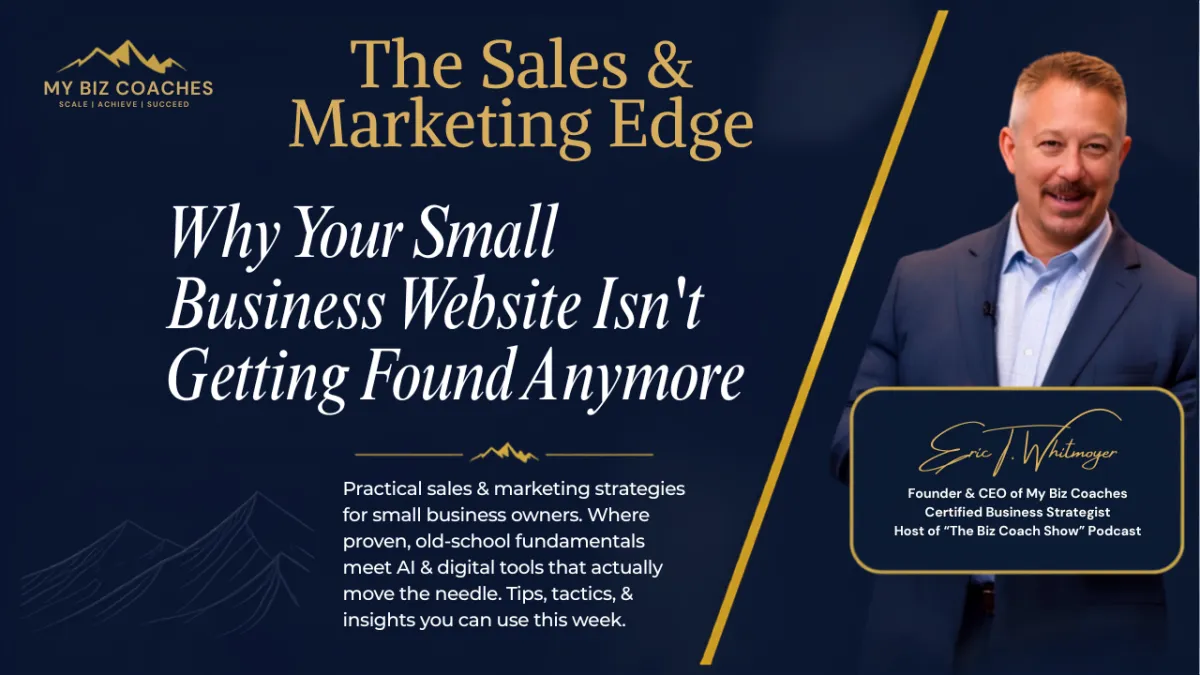
Why Your Small Business Website Isn't Getting Found Anymore
Your website is not a brochure.
It's either your best salesperson or your most expensive lawn ornament, and most owners have no idea which one they're paying for.
Here's what changed while everyone was arguing about logos and color palettes. For twenty years, owners were told to build a small business website so people could find them on Google. That advice is now half wrong. Buyers aren't only searching. They're asking. And what answers them isn't ten blue links.
According to BrightLocal's Local Consumer Review Survey 2026, 45% of consumers now use AI tools to get local business recommendations. The year before, that number was 6%. AI is now the third most popular way people find local businesses, behind Google and Facebook, and ahead of Yelp.
6% to 45% in twelve months.
What that actually means for your website
Say a buyer opens ChatGPT and types "best commercial cleaning company near me." Your site either gets pulled into that answer or it doesn't exist. There's no page two to hide on. There's one answer, and maybe three names in it.
That's the findability problem. It's only half of it.
The second that person lands on your site, your website stops being marketing and becomes a salesperson. It has to qualify them, build trust, handle the obvious objection, and ask for the meeting. Most small business sites do none of that. They say About Us, Our Services, Contact, and then wait like a store clerk hiding in the back room.
✳️ Marketing earns the attention. The site converts it. When owners treat those as two separate jobs, revenue leaks out of the gap between them.
Plain English on SEO, AEO, and GEO
Three acronyms, one idea: getting found.
1️⃣ SEO is optimizing so Google's traditional results rank your pages.
2️⃣ AEO (answer engine optimization) is structuring your content so an AI assistant can lift a clean, direct answer straight off your page and hand it to the user.
3️⃣ GEO (generative engine optimization) is building enough credibility signals, citations, real data, named sources, and consistent business information that AI models pick you as the one worth naming.
SEO gets you ranked. AEO gets you quoted. GEO gets you recommended.
Where this shows up by phase of scale
In the Creator phase ($0 to $100K), the site is usually a template with a stock photo of a handshake. The owner's real lead source is their phone. That's fine for now. The mistake is spending $8,000 on a beautiful site before knowing what message actually closes.
In the Hustler phase ($100K to $250K), the site becomes the first thing a referral checks before calling. It's not generating leads yet. It's killing them or confirming them.
In the Operator phase ($250K to $500K), the owner adds a form and stops answering it within the hour. Speed to lead collapses. The website gets blamed.
In the Architect phase ($1M to $3M), the site has to feed a team. Founder-led sales stops scaling here, and the site either qualifies leads before a rep touches them or the reps drown in tire-kickers.
In the Optimizer phase ($3M to $10M), the site is a measurable asset with its own conversion rate, cost per lead, and contribution to customer acquisition cost. At this phase, you're not fixing a website. You're managing a channel.
The thing I got wrong for years
When my partner and I acquired a single wireless store and pushed it to ten locations and over $1M in sales in three years, I did what most owners do. I chased traffic. More foot traffic, more calls, more promotions.
Thirty years of getting sent into underperforming stores and markets as the guy who cleans up the mess taught me the pattern the hard way. The store almost never had a traffic problem. It had a conversion problem wearing a traffic problem's clothes.
The same thing happens online. In 7 years as a business coach working hands-on with 170+ clients, when an owner tells me their lead generation isn't working, we pull the numbers first. More often than not, the traffic is fine. The site converts at 0.8% when the category average is closer to 3%. They don't need more visitors. They need the same visitors to do something.
Per WordStream's conversion rate optimization research, citing Portent, B2B sites that load in one second convert five times better than sites that take ten. That's not a design problem. That's a revenue problem hiding in a technical setting nobody checked.
What to fix on your small business website this quarter
✅ Answer the question your buyer actually types, in the first two sentences of the page. AI engines quote content that answers fast.
✅ Build one page per service, per market. One page trying to serve six services is invisible to all six.
✅ Add a plain FAQ block to every service page, written the way a customer would ask an assistant out loud.
✅ Make your business name, address, phone, and service description identical everywhere online. AI models cross-check. Inconsistency reads as untrustworthy.
✅ Cite real sources and publish real numbers. Models prefer content that cites.
✅ Put one clear next step above the fold. One.
❌ Don't hide your phone number behind a contact page.
❌ Don't write "we offer world-class solutions." No one asks an AI for a world-class solution.
❌ Don't launch a redesign before you know your current conversion rate. You'll never know if it worked.
❌ Don't buy more ads to cover for a site that isn't closing.
➡️ Track these four numbers monthly: Website conversion rate (visitors to leads), cost per lead, lead-to-close rate, and customer acquisition cost against lifetime value. Everything else is decoration. Sessions and impressions feel good and predict almost nothing.
One question for you
If a buyer asked an AI assistant today who the best option in your category is, and your name never came up, would you actually know?
Quick Answers
How is AEO different from SEO for a small business website? SEO gets your page ranked in a list of results. AEO gets your content quoted directly inside an AI-generated answer, where there's no list to scroll. Both matter, but AEO rewards clear, direct answers and structured content over keyword volume.
What's a good conversion rate for a small business website? For most local service businesses, 2% to 5% of visitors becoming leads is a workable range, and anything under 1% usually signals a messaging or speed problem rather than a traffic problem. The number matters less than knowing yours and tracking it monthly.
Do I need a new website to show up in AI search? Usually not. In the Creator and Hustler phases ($0 to $250K), fixing your messaging, service pages, and business listings does more than a redesign. My Biz Coaches works with owners to diagnose which side is broken, findability or conversion, before anyone spends money on either.
Let's fix the side that's actually broken
Most owners guess. Then they spend.
➡️ Try our Website Audit Tool: Go to https://partnerproagency.com/ to run our Website Audit Tool and see how your site fares with the new standards for AI.
➡️ Free coaching session: Bring me your website and your last 90 days of lead numbers. In one call, we'll identify whether you have a findability problem or a conversion problem, and what My Biz Coaches would do about it first.
➡️ Become a Certified My Biz Coach: If you've built and sold businesses and want to build a coaching practice that actually pays, this is how you do it with a proven system behind you.
Sincerely,
Eric T. Whitmoyer, Business Growth Strategist
Founder & CEO at MyBizCoaches.com
Host of The Biz Coach Show
From Startup to Exit, We're There for Your Biggest Decisions
P.S. Curious where your business really stands? My Biz Navigator is a free 5-minute assessment that shows you exactly what's working and what it's quietly costing you.
Take it here → www.MyBizNavigator.com
Because the difference between ordinary and extraordinary isn't luck; it's the information you act on.
A home services client came to us begging for a website redesign.
We told them no. Then promptly fixed their follow-up call script instead.
Same traffic. Same ad budget. Revenue up 61% in 90 days.
Most owners chase leads when they actually have a conversion problem. More traffic just means more prospects falling through the same broken process, faster.
This week I break down the exact numbers: what "good" conversion looks like, what to track instead of vanity lead counts, and how to tell if your business has a lead problem or a closing problem.
#SalesAndMarketing #SmallBusiness #TheSalesAndMarketingEdge #LeadGeneration #ConversionRate
CTA comment (Survival Guide / Biz Navigator) Not sure if this is you or your team, want a straight answer? Run the free My Biz Navigator assessment. Five minutes and it'll show you exactly where the leak is. www.MyBizNavigator.com
Insight / experience-based comment Saw this a hundred times as the "cleaner" walking into underperforming stores. Everyone wanted a marketing fix. Most of the time the rep on the floor just didn't know how to close what was already standing in front of them.
Agreement / validation comment This. So many owners buy more ad spend as a coping mechanism instead of listening to their own sales calls.
Question-driven engagement comment Genuine question for the room: when's the last time you actually listened to one of your own sales calls start to finish?
Thoughtful / mildly contrarian comment Unpopular opinion maybe, but a bad sales process is cheaper to fix than a bad marketing strategy. You just have to be willing to look at it.


