Join the Biz Coach Insider Newsletter
Weekly insights for founders serious about scaling — delivered to your inbox.
Biz Coach Insider
A Weekly Newsletter by Eric of My Biz Coaches
Weekly dedicated insights for entrepreneurs and business leaders committed to growth, strategy, and mastery.
Blogs
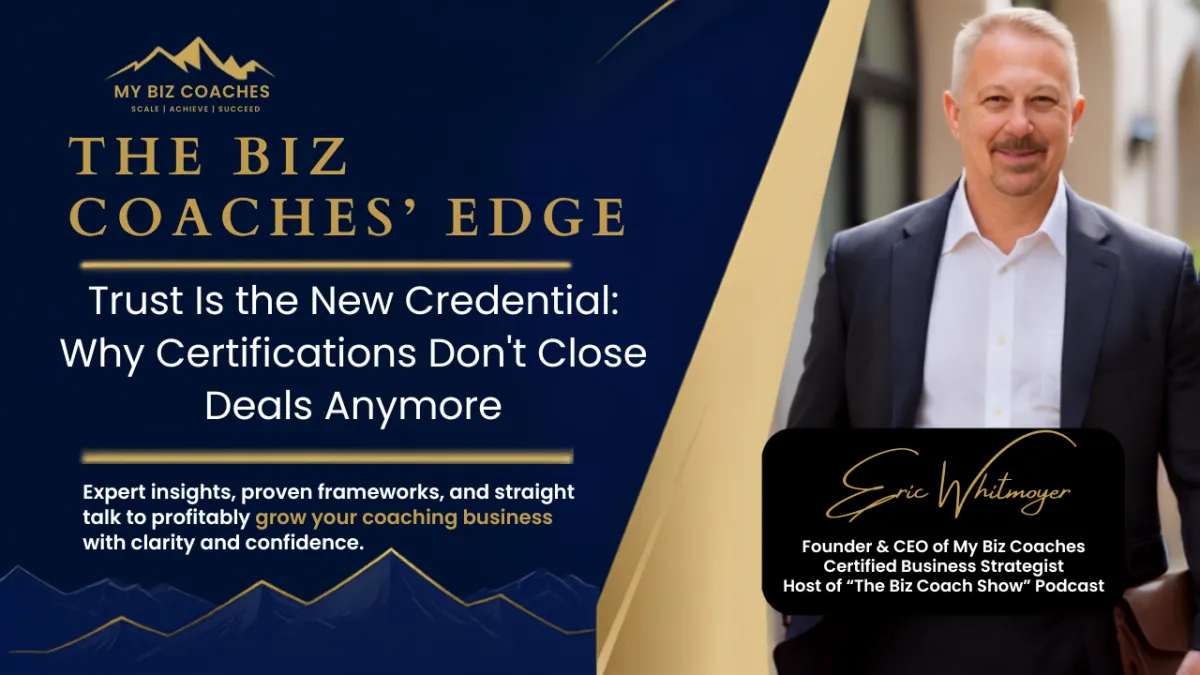
Trust Is the New Credential: Why Certifications Don't Close Deals Anymore
What Actually Makes an Owner Say Yes
Across 170+ client relationships, I can count on one hand how many times someone asked about my credentials before they signed.
Not once did a certificate close a deal. What closed deals was a business owner deciding, usually before we ever got on a call, that I understood their problem and wouldn't waste their time.
That's an uncomfortable thing to read if you just spent $12,000 and eight months earning a certification. So let me be clear about what I'm not saying. I'm not saying credentials are worthless. I'm saying they've quietly changed jobs on you. They used to be the reason someone picked you. Now they're the reason someone doesn't rule you out. Those are two very different things, and confusing them is why a lot of well-trained coaches are sitting on an empty calendar.
The Math Nobody Wants to Do
The 2025 ICF Global Coaching Study counted 122,974 active coach practitioners worldwide, a 13% jump in two years. The market grew right alongside them, reaching $5.34 billion in annual revenue, up 17%. Good news, on the surface.
Here's the number that should stop you. Average annual revenue per coach: $49,283.
The industry got bigger. The average coach didn't. More coaches, more training programs, more credentials in circulation, and the typical practitioner is still earning less than a decent salaried job. Supply grew faster than any individual coach could stand out.
And now the honest counterweight. ICF's consumer research found nearly 80% of respondents said a coach's certification or credential would be important or very important to them. So credentials do matter. They're a filter. They get you into the consideration set. They just don't get you signed, because in a field of 122,000 practitioners, roughly everyone in that consideration set has one.
A filter is not a differentiator. If what you're leading with is the same thing everyone else has, you haven't given the buyer a reason to choose you. You've given them a reason to shop.
What the Data Says Actually Closes
The 2024 Edelman-LinkedIn B2B Thought Leadership Impact Report surveyed 3,484 business executives and decision-makers. The findings are blunt.
73% said an organization's thought leadership is a more trustworthy basis for assessing its capabilities than its marketing materials.
86% said they'd be moderately or very likely to invite an organization that consistently produces high-quality thought leadership into an RFP process.
60% said good thought leadership makes them willing to pay a premium.
And 9 in 10 said they're more receptive to outreach from a company that consistently publishes it.
Read those four numbers again and notice the word doing the work: consistently. Not brilliantly. Not virally. Consistently. The buyer isn't scoring your best post. They're watching whether you show up, whether you say the same thing in June that you said in February, and whether what you say lines up with what they're actually living. That's how trust gets built in public, and it's the closest thing to a real differentiator this industry has left.
Where This Shows Up by Phase
In the Creator phase, $0-$100K, most new coaches lead with the credential because it's the only thing they have that feels like proof. Understandable. It's also the weakest asset in the bag. The faster move is to pick one specific problem you've personally solved and say something useful about it every week, in public, whether anyone claps or not.
In the Hustler and Operator phases, $100K-$500K, the coach has results but no visible track record. Wins are locked inside private client relationships that no prospect can see. This is where most practices stall. Not from lack of skill. From lack of evidence a stranger can find.
In the Leader phase, the coach starts building a team or partner bench, and trust has to transfer beyond the founder's face. If every deal closes because of you personally, you don't have a practice yet. You have a job with better hours.
In the Architect phase, reputation becomes the asset that outperforms outreach. Deals arrive already half-sold. That's not luck. It's what several years of consistent, specific, useful content compounds into.
What I Learned the Hard Way
My first coaching clients didn't come from a credential. They came from people who'd watched me run companies, watched me make hard calls, and decided I was worth listening to.
For a while, I read that as proof credentials didn't matter. That was wrong, and it cost me. What I actually had was a twenty-year track record other people could see. Most coaches starting out don't have that yet, and telling them to "just be trusted" is useless advice.
The real lesson took longer. Trust isn't a personality trait. It's an asset you build on purpose, in public, over time. I've watched superbly certified coaches with better technical training than mine struggle for years because nobody outside their client list knew what they stood for. I've also watched coaches with modest credentials build waiting lists because they showed up every single week and said something true about one specific problem.
The certificate got them in the room. The consistency got them the business.
Practical Guidance for Coaches
1️⃣ Move the credential off your headline and into your bio. Lead with the problem you solve and who you solve it for. Let the certification be the reassurance a prospect finds after they're already interested.
2️⃣ Pick one problem and own it publicly for 90 days. Not a topic. A problem, specific enough that the right owner reads it and thinks that's my exact situation.
3️⃣ Publish on a cadence you can survive. Weekly beats brilliant. The Edelman data rewards consistency, not fireworks, and a schedule you abandon in month two does more damage than never starting.
4️⃣ Turn private results into public evidence. Get permission, use real numbers, and show the before and after. One documented client outcome outperforms three certifications on a sales call.
✅ DO earn a credential if it gives you frameworks and tools you don't have yet. That's the real return on it.
✅ DO say the uncomfortable, specific thing in your content. Generic advice builds zero trust because it signals zero experience.
✅ DO make your track record findable by someone who has never met you.
❌ DON'T treat the certificate as a marketing strategy. It qualifies you. It doesn't sell you.
❌ DON'T collect a second and third credential to fix a pipeline problem. More training will not solve a visibility problem.
❌ DON'T go quiet between launches. Trust decays when you only show up to sell.
➡️ Your credential answers "is this person qualified." Your consistency answers "do I believe this person?" Owners only pay for the second one.
A Question for You
If a prospect who's never met you spent ten minutes searching your name right now, what would they find? And would it convince them you understand their problem, or just that you finished a program?
Quick Answers
Do I need a business coaching certification to get clients? No state licenses business coaches the way it licenses CPAs or attorneys, and no certification guarantees clients. But ICF consumer research shows nearly 80% of prospective clients consider a credential important, so it functions as a filter that keeps you in the running. A business coaching certification is most valuable for the frameworks, diagnostic tools, and structured approach it gives a new coach, not as a marketing message.
How do business coaches actually get clients? Consistently, publicly, and by demonstrating they understand a specific problem before ever being hired. The 2024 Edelman-LinkedIn research found 73% of decision-makers trust an organization's thought leadership over its marketing materials, and 86% would invite consistent publishers into a buying process. For coaches, that means visible, regular, specific content plus documented client outcomes will out-produce credentials on a business card.
Is a coaching franchise worth it compared to licensing? A coaching franchise typically means a six-figure buy-in and real operating restrictions in exchange for a brand and a system. A licensing model like Certified My Biz Coach gives coaches proven tools, brand support, and a community of Coach Partners without that level of investment or restriction, which makes it a practical middle path for professionals, including fractional executives, deciding how to enter the market.
If This Hit Close to Home
If you're a coach, consultant, or fractional executive who's tired of competing on credentials in a field of 122,000 people, the Certified My Biz Coach license is built to solve exactly that. You get proven diagnostic tools, our brand, a content and client-facing system already built, and a community of roughly 25 Coach Partners, without the six-figure investment or the restrictions of a coaching franchise. Learn more about becoming a Certified My Biz Coach at MyBizCoaches.com.
If you'd rather talk it through than read about it, I'm glad to have that conversation. Reach out for a free conversation this week, and we'll look honestly at whether this path fits your background.
And if you're coaching owners who can't articulate why a customer should pick them over the competitor down the street, the 2026 Business Survival Guide walks through the positioning and differentiation work directly. It's free. Download the Guide here.
If you coach clients through positioning and growth, put the My Biz Navigator in front of them. It's a free 5-minute assessment that shows exactly what's working in their business and what it's quietly costing them.
To Your Success,
Eric T. Whitmoyer, Business Growth Strategist
Founder & CEO at MyBizCoaches.com
Host of The Biz Coach Show
From Startup to Exit, We’re There for Your Biggest Decisions
P.S. If you’re serious about taking your business to the next level, then you may find value in getting a copy of our 2026 Business Survival Guide, full of strategies, tactics, and solutions to help move your business forward faster this year.
Because the difference between ordinary and extraordinary isn’t luck; it’s the information you act on.
Consider becoming a Certified My Biz Coach – Learn More HERE.

Get In Touch
Email: [email protected]
Address
Office: 2622 E. Palm Beach Rd.
Assistance Hours
Monday to Saturday - 9:00am to 8:00pm
Sunday - CLOSED
Phone Number:
(623) 294-3795

Empowered Growth With Coaching
Trusted by owners who scaled past $10M and beyond.
© 2026 - All Rights Reserved