
Explore More My Biz Coaches Content
The Biz Coach Show
The Podcast of My Biz Coaches
Get weekly educational videos to help you learn how to scale your business, achieve your goals and experience success in all aspects of your life. Stream it on YouTube, Spotify and Apple Podcasts.
Biz Coach Insider
A Weekly Newsletter by Eric T. Whitmoyer
My Biz Coaches
Weekly dedicated insights for entrepreneurs and business leaders committed to growth, strategy, and mastery.

PARTNER WITH US
Partnership Opportunities
Put your brand in front of business owners, coaches, and leaders who are actively investing in growth. We partner with brands through The Biz Coach Show podcast and the Biz Coach Insider newsletter.
The Biz Coach Show
Weekly episodes on YouTube, Spotify, and Apple Podcasts focused on scaling, leadership, and growth.
- Sponsored episode segments
- Brand and founder interviews
- Product features and walkthroughs
Biz Coach Insider
Our weekly newsletter delivering practical strategy to entrepreneurs and business leaders.
- Featured articles and reviews
- Sponsored placements
- Cross-promotion on LinkedIn
Affiliate and referral partnerships: we recommend tools our clients use in AI, marketing, finance, and operations. Revenue share and bundled packages available.
Blogs
Biz Coach Insider+ - Fifty-First Edition
Competency: Financial Acumen Phase of Scale: Investor thinking (Phase 8), applied from Operator (Phase 3) up
Most owners grow in one direction. Build it. More marketing, more hires, more hours.
There's a second direction most never consider. Buy it.
Two weeks ago in my daily posts we compared buying a competitor to outselling one. This week I'm showing you the math from the inside, because I'm reviewing a small acquisition myself.
It's a profitable service business built on a platform we already know well, with recurring monthly clients and working automations. The asking price is roughly 1x annual revenue. The sellers are open to carrying a note.
✳️ A business you can buy with its own cash flow is often cheaper than a business you have to build from zero.
Why buying can beat building
Build a new service line and you start at zero. No clients. No systems. No reputation. A year or more to profitability.
Buy a small, profitable business and on day one you get:
✅ Customers already paying monthly
✅ Systems already built and running
✅ Cash flow that helps pay for the purchase
✅ Relationships you couldn't reach alone
In the deal I'm reviewing, one existing client is actively looking for a referral partnership that could open a much larger market. You don't get that from scratch.
"1x revenue" is not the real price
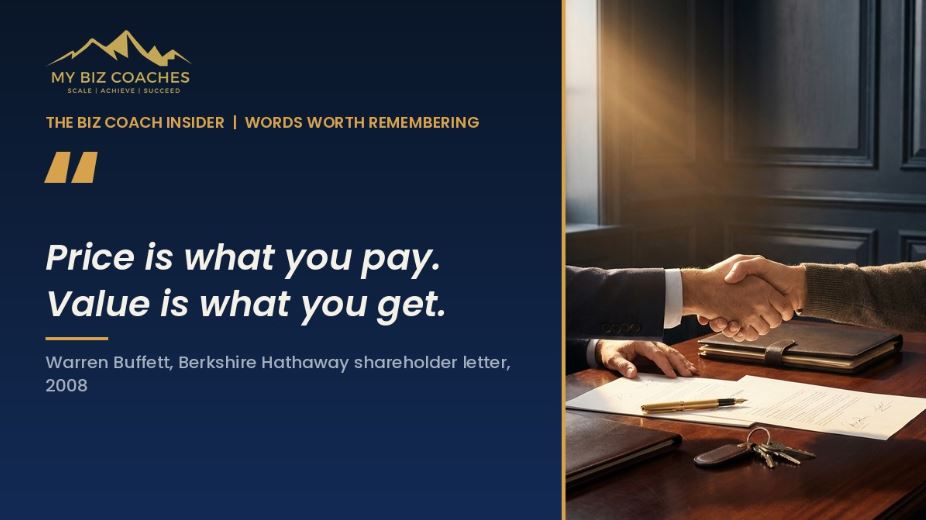
Warren Buffett put it best: "Price is what you pay. Value is what you get."
A price quoted as a multiple of revenue sounds simple. It can mislead you. What matters is what the business earns for its owner, usually measured as Seller's Discretionary Earnings (SDE): net profit, plus the owner's pay, plus one-time or personal expenses run through the books.
In my deal, the business kept about half its revenue as profit over the last 12 months. So "1x revenue" is really about 2x earnings. A reasonable number for a small business. But you only see it if you do the math.
When I was on the inside of our wireless retail exit, the deal that came close to nine figures, I watched buyers do this exact work. They didn't argue about revenue. They rebuilt earnings line by line and priced the risk.
Normalize the numbers
Recent months in my deal looked expensive at first. A large one-time software charge had hit the books and was later refunded. Part of the costs was a pass-through service billed straight back to clients. Take those out and the margins made sense.
➡️ Ask the seller to walk you through every month that looks unusual. The story behind the number matters more than the number.
The 5-point Deal Screen
Before price, before terms, every deal goes through five questions. Fail two and I walk.
1️⃣ Owner dependence. If the owner disappears, does it still run? A business that lives in the owner's head is a job, not an asset.
2️⃣ Recurring revenue. How much repeats every month without a new sale?
3️⃣ Concentration. Does any one client make up more than 20% to 25% of revenue?
4️⃣ Normalized earnings. After one-time costs and add-backs, what does it really earn?
5️⃣ Transferability. Can every account, contract and login move cleanly to you? Domain, CRM, payment processor, ad accounts. (Thursday's post on who owns your logins covered why.)
Structuring with seller financing
Seller financing means the seller lets you pay part of the price over time. In small deals it's common, and it's a good sign. A seller willing to carry a note believes the business will keep performing.
✳️ Down payment at closing, from cash or a loan
✳️ Seller note for the balance, paid monthly at an agreed rate
✳️ Transition support, often 30 to 90 days, to introduce you to clients and hand off systems
Have your attorney and CPA review any structure before you sign. Rates, what happens if revenue drops, and the non-compete all matter.
The KPI that decides it: Debt Service Coverage
DSCR = annual SDE ÷ annual debt payments
Earn $1.50 for every $1.00 of loan payments (a DSCR of 1.5) and the deal pays for itself with room to spare. Lenders commonly look for at least 1.25. Below 1.0, you're paying for the business out of your own pocket.
❌ Don't run it on the best case. Run it on the worst case. What if your biggest client leaves in month two?
Your 90-day integration plan
1️⃣ Days 1 to 30: change nothing customers can see. Meet every client.
2️⃣ Days 31 to 60: move the back office. Accounts, billing, software. Document every process.
3️⃣ Days 61 to 90: add value. Introduce your other services. Activate referral partners.
❌ The biggest mistake new buyers make is changing too much, too fast. Clients bought from the old owner. Earn their trust first.
What this looks like as you scale
Operator ($250K to $500K): a small tuck-in can add customers and systems faster than another hire.
Leader ($500K to $1M): you have a team that can absorb a second business. Integration becomes the skill.
Architect ($1M to $3M): acquisitions become a strategy, not an event. Build a repeatable screen.
Investor ($25M to $100M+): capital allocation is the job. You don't have to wait until here to think this way.
In The CEO's Playbook for Scale, Phase 8 is about capital allocation, M&A and exits. Small acquisitions are one of the fastest ways to jump from Operator to Architect, because you're buying systems and customers instead of building them one at a time.
Coaching Corner
If you're a coach, consultant or fractional leader, this applies to you twice.
For your clients: run their business through the Deal Screen before they ever think about selling. Whatever fails the screen is your coaching plan for the next 12 months.
For your own practice: if your coaching business is only you doing 1-on-1 calls, it fails point 1. Nobody can buy it. That's why I built a team of roughly 25 Coach Partners on one shared playbook.
Your action steps this week
✅ Write down 3 types of businesses that would fit beside yours
✅ Run your own business through the Deal Screen
✅ Calculate your current DSCR on any debt you carry today
To Your Success,
Eric T. Whitmoyer, Business Growth Strategist
Founder & CEO at MyBizCoaches.com
Host of The Biz Coach Show
Author of The CEO's Playbook for Scale
From Startup to Exit, We're There for Your Biggest Decisions
P.S. Curious where your business really stands? My Biz Navigator is a free 5-minute assessment that shows you exactly what's working and what's quietly costing you. Take it here → MyBizNavigator.com
Because the difference between ordinary and extraordinary isn't luck; it's the information you act on.
Thinking about financing a deal? MBC Finance can help you compare an SBA loan, a seller note and a line of credit before you sign. Book a free session: bit.ly/AssessmentMeeting
Consider becoming a Certified My Biz Coach: Learn More HERE.

Empowered Growth With Coaching
Trusted by owners who scaled to $10M and beyond.
© 2026 - All Rights Reserved