Explore More My Biz Coaches Content
The Biz Coach Show
The Podcast of My Biz Coaches
Get weekly educational videos to help you learn how to scale your business, achieve your goals and experience success in all aspects of your life. Stream it on YouTube, Spotify and Apple Podcasts.
Biz Coach Insider
A Weekly Newsletter by Eric T. Whitmoyer
My Biz Coaches
Weekly dedicated insights for entrepreneurs and business leaders committed to growth, strategy, and mastery.
Blogs
Biz Coach Insider+ - Forty Forth Edition
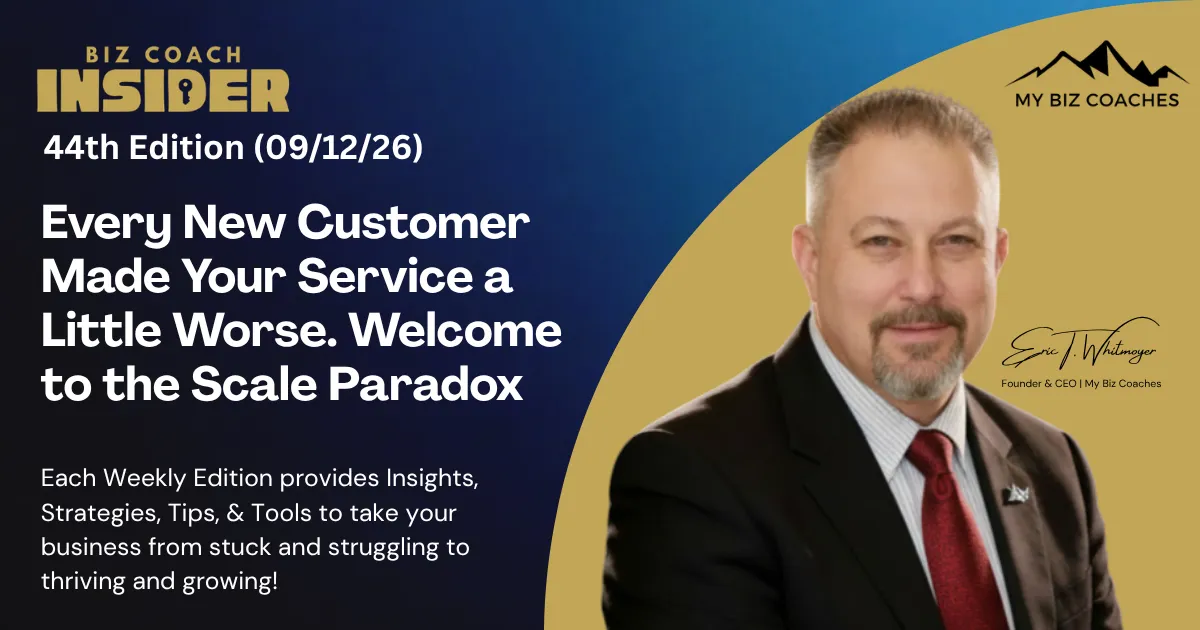
Biz Coach Insider - 44th Edition (9/12/26) - Every New Customer Made Your Service a Little Worse. Welcome to the Scale Paradox
Competencies: Customer Service + Operational Excellence | Phases: Operator ($250K–$500K) → Architect ($1M–$3M)
Saltbox's 2026 small business analysis names two challenges that sound like separate problems. Loss of customer experience control. Fragmented fulfillment. They're the same problem wearing two names.
Here's the data behind why it matters. According to RetailDive, 73% of consumers stop buying from a brand after three or fewer bad experiences. Not three bad products. Three bad experiences. Late replies, a missed handoff, a promise nobody remembered making.
✳️ Nobody builds a service business planning to break their own customer experience. It happens by accident, one new client at a time, because the thing that won your first fifty customers was you. And you don't scale.
The Trap Nobody Sees Coming
At $250K to $500K, you're the Operator. You answer the phone. You remember that this client hates being called before 10am and that one wants everything in writing. You catch problems before they become complaints because you're standing close enough to see them coming.
That's not a system. That's you, personally, functioning as quality control for every single account. It works beautifully at twelve clients. It works less beautifully at thirty. By eighty, you're not delivering a worse service on purpose, you're delivering it through more hands, more handoffs, and more places where the thing you used to catch personally now slips through.
The owner doesn't feel the decline first. The customer does. Then the review does. Then you're in a meeting asking why retention dropped when the team is "working just as hard as ever."
Why Working Harder Doesn't Fix It
Here's the part that trips up good operators. Your instinct when service quality slips is to lean in harder. Answer more calls yourself. Personally check more orders. Jump on more accounts when something goes sideways.
That instinct is exactly backwards. It was the right move at $250K. At $500K and climbing, it's you trying to be the system instead of building one. You can't out-hustle math. If your personal attention is the quality control mechanism, and your customer count triples, your attention doesn't triple with it. Something has to give, and it's usually the thing your customers actually notice.
I've worked with 170+ owners over the last 7 years, and the ones who break through this stage aren't the ones who work harder. They're the ones who get honest about which parts of "great service" were actually them, and which parts were a repeatable standard the business enforces regardless of who's on shift.
What Actually Breaks First
➡️ It's rarely the big, obvious moments. It's the small standards nobody wrote down because they lived in your head. The turnaround time you always hit without thinking about it. The way you always followed up after a delivery, even when nothing went wrong. The tone you used when something did.
Those unwritten standards are the first casualties of growth, because they were never actually standards. They were habits, and habits don't transfer to a new hire, a new vendor, or a new shift. Fragmented fulfillment is just what it looks like when nobody defined the handoff points, so every new person invents their own version of "good enough."
Turning the Personal Touch Into a Designed Standard
The fix isn't hiring someone to be you. It's deciding, on paper, what "great service" actually consists of, so it survives contact with someone who isn't you.
Start with the moments customers actually remember. Not every touchpoint matters equally. Response time on the first inquiry, communication during any delay, and what happens the moment something goes wrong. Those three moments carry most of the weight in whether a customer stays or leaves. Everything else is worth systematizing eventually, but those three are worth systematizing first.
Write the standard down as a number, not a feeling. "We respond fast" trains nobody. "We respond within four business hours, every time" trains everybody, including new hires who've never met you. A designed standard is boring on purpose. Boring is what makes it repeatable without you in the room.
Why This Hits Hardest at Operator to Architect
At Operator, $250K to $500K, the personal touch is genuinely your competitive advantage. Don't apologize for it. But start documenting it now, before growth forces the conversation. Owners who wait until service is visibly cracking document under pressure, which is a much worse way to build a system.
At Architect, $1M to $3M, this stops being optional. You're hiring faster than you can personally train, and every new person without a written standard is quietly redefining what your brand means to the next customer they touch. This is exactly where Operational Excellence has to catch up to Customer Service, or the thing that built the business starts dismantling it.
The Three Moves That Actually Work
1️⃣ Name the three moments that make or break a customer's experience with you. First response, delayed communication, and problem recovery cover most of it for most service businesses.
2️⃣ Turn each one into a number. A time limit, a required step, a specific phrase, or a process. If you can't measure it, you can't enforce it past you.
3️⃣ Audit one full customer journey a month as if you were the customer, not the owner. You'll catch the gap between what you think happens and what's actually happening.
Build It in the Right Order
Do this first:
✅ Write down the three moments in the customer journey that matter most, based on what actually drives your reviews and referrals.
✅ Turn each into a measurable standard your newest hire could follow without asking you.
✅ Build a simple checkpoint, a checklist, a handoff log, anything that catches slippage before the customer does.
✅ Review one real customer journey monthly, start to finish, looking for wherever your personal habit was doing the job a system should be doing.
Don't do this first:
❌ Don't respond to declining service by personally jumping into more accounts. That's not a fix; it's a delay.
❌ Don't wait until reviews turn negative to define your standards. Define them while you still have room to adjust quietly.
❌ Don't try to systematize everything at once. Three moments, done well, beat twenty standards nobody follows.
❌ Don't assume your team knows what "great service" means just because you do. They've never seen inside your head.
Coaching Corner
Watch for this with any client between Operator and Architect who describes their service as "personal" or "high-touch" like it's permanently their edge. It is, until headcount and customer count both climb, and then it quietly becomes their biggest operational risk. Your job is to help them separate the parts of their service that are genuinely them, the parts only the founder should deliver, from the parts that are actually a standard hiding as a personality trait.
Run this on your own coaching practice too. If your onboarding, your session prep, or your follow-up only works because you personally remember to do it a certain way, that's the same trap in a different outfit. It's exactly why Partner Pro Agency exists, to take the execution side of a coaching business and turn it into something that runs the same whether you're the one doing it or not.
The Book Hook
This is Customer Service paired with Operational Excellence in The CEO's Playbook for Scale, and the order they show up in matters. Customer Service tells you what "good" is supposed to feel like from the outside. Operational Excellence is what makes that feeling survive being delivered by someone other than you. An owner strong in one and weak in the other either has a service nobody can describe, or a system nobody would actually want to receive.
The growth that's straining your service right now isn't a sign you did something wrong. It's a sign the thing that got you here needs to become something more than you. That's not a demotion. That's the job at this phase.
To Your Success,
Eric T. Whitmoyer, Business Growth Strategist
Founder & CEO at MyBizCoaches.com
Host of The Biz Coach Show
From Startup to Exit, We're There for Your Biggest Decisions
P.S. If you're serious about taking your business to the next level, then it's time to stop figuring it out alone. The Biz Mastery Network was built for owners who want structure, strategy, and real execution support without the noise. It includes The Biz Coach Insider Newsletter, designed specifically for busy business owners who need clarity fast and results faster.
Because the difference between ordinary and extraordinary isn't luck; it's the information you act on.
Consider becoming a Certified My Biz Coach – Learn More HERE.

Empowered Growth With Coaching
Trusted by owners who scaled to $10M and beyond.
© 2026 - All Rights Reserved