Explore More My Biz Coaches Content
The Biz Coach Show
The Podcast of My Biz Coaches
Get weekly educational videos to help you learn how to scale your business, achieve your goals and experience success in all aspects of your life. Stream it on YouTube, Spotify and Apple Podcasts.
Biz Coach Insider
A Weekly Newsletter by Eric T. Whitmoyer
My Biz Coaches
Weekly dedicated insights for entrepreneurs and business leaders committed to growth, strategy, and mastery.
PARTNER WITH US
Partnership Opportunities
Put your brand in front of business owners, coaches, and leaders who are actively investing in growth. We partner with brands through The Biz Coach Show podcast and the Biz Coach Insider newsletter.
The Biz Coach Show
Weekly episodes on YouTube, Spotify, and Apple Podcasts focused on scaling, leadership, and growth.
- Sponsored episode segments
- Brand and founder interviews
- Product features and walkthroughs
Biz Coach Insider
Our weekly newsletter delivering practical strategy to entrepreneurs and business leaders.
- Featured articles and reviews
- Sponsored placements
- Cross-promotion on LinkedIn
Affiliate and referral partnerships: we recommend tools our clients use in AI, marketing, finance, and operations. Revenue share and bundled packages available.
Blogs
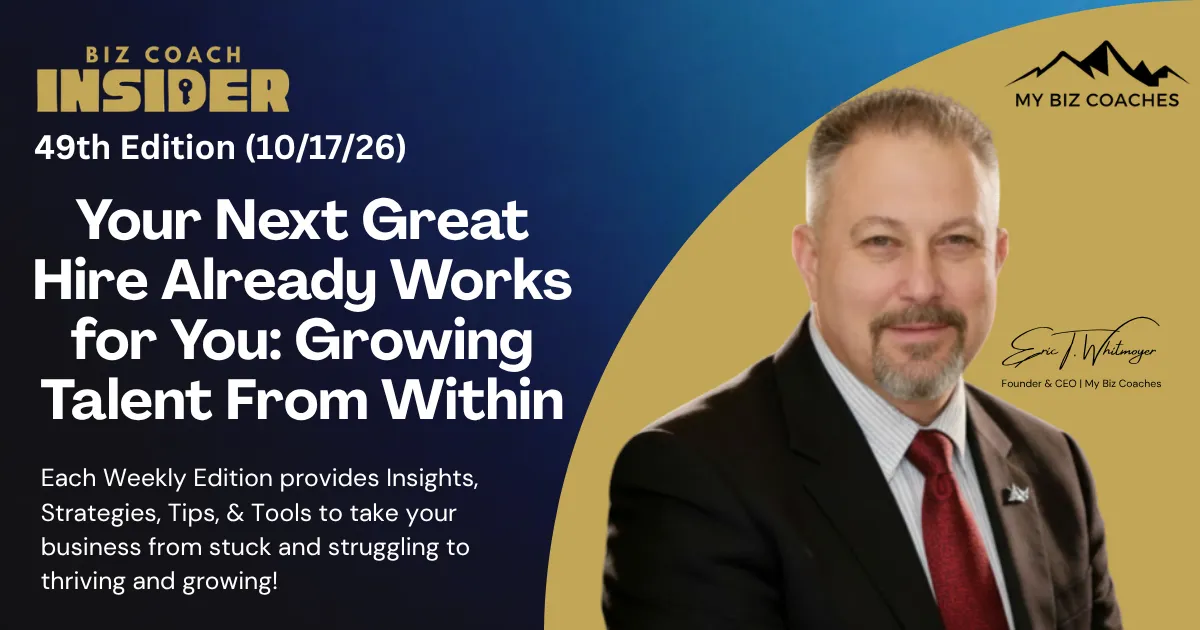
Biz Coach Insider+ - Forty Ninth Edition
Three things worth your next 5 minutes. All three are about the people already on your payroll.
Your Next Great Hire Already Works for You
NFIB's September 2026 jobs report says only a net 17% of small business owners plan to add jobs in the next three months. And 87% of owners who are hiring or trying to hire found few or no qualified applicants.
So most of you aren't adding headcount this year. Fine. Capacity doesn't have to come from new bodies. It can come from the people you already pay.
Build a simple internal development path. Three pieces:
1️⃣ Cross-training. Every critical task has a second person who can do it. Not perfectly. Well enough that a sick day isn't a crisis.
2️⃣ Ownership of outcomes. Stop handing out tasks. Hand out results. "Own the schedule so we never run short on Saturdays" grows a person. "Make the schedule" doesn't
3️⃣ A growth ladder. Write down what the next level looks like: what they own, what they decide, what they earn. People stay where they can see a next step.
✳️ Development is the cheapest raise you'll ever give. It lifts capacity and retention at the same time.
When my partner and I grew one wireless store to 10 in three years, we didn't hire 10 store managers. We grew most of them from the sales floor. That's why the math worked.
The CEO's Playbook for Scale frames People Management this way: leadership leverage comes from multiplying people, not collecting them.
➡️ This week's move: list your three most critical tasks. Name a backup for each. Start cross-training Monday.
The Bench You Need at Operator Isn't the Bench You Need at Optimizer
At Operator ($250K to $500K), you probably have 3 to 10 people. Development happens by proximity. They watch you, they learn. The risk: every key skill lives in one head, usually yours or your one star employee's. Your job here is depth. Cross-train until no single absence stops the business.
Through Leader and Architect, you hand off the first management seat. That's your first manager, and the best candidate is usually already on your team.
By Optimizer ($3M to $10M), the problem flips. You have managers. Do they develop people, or just supervise them? A manager who hoards the work caps the whole department at their personal capacity. Now the bench is a system, not a habit.
What to let go of: being the main teacher. At Operator, you're the trainer. At Optimizer, you train the trainers:
✅ Operator: a one-page cross-training grid, names by task
✅ Optimizer: every manager names a successor and gets measured on developing them
❌ Promoting your best doer and calling it a development plan
❌ Waiting for a resignation to find out who's ready
If your best person gave notice Friday, who steps in Monday?
➡️ This week's move: Operator, build the grid. Optimizer, ask each manager to name their successor. If they can't, that's your answer.
Write It Down Once. It Trains Your Team and Builds Your Name.
The fastest way to develop people is to stop making them learn by osmosis. Write down how you do things.
Most owners carry their best material in their heads. How you price a job. How you calm an angry customer. How you decide who's ready for more. Every new person needs it, so you explain it again. And again.
Thirty years of being sent in to fix struggling stores taught me this: they rarely lacked talent. They lacked a written standard anyone could train to.
Start small:
1️⃣ List the 10 questions your team asks you most.
2️⃣ Answer each one on a single page, in your own words.
3️⃣ Hand them to your next new person. Fix whatever confuses them.
That's an internal training playbook. It's also, very often, the first draft of something bigger. Those same answers become articles, podcast episodes, a lead magnet, sometimes a book. A book that captures how you run things does two jobs. It trains the people inside. And it builds trust with people outside before they ever call you. Referrals land warmer when prospects have already read how you think.
That's how The CEO's Playbook for Scale came together: Years of the same lessons, finally written down once.
If you'd like to turn your playbook into a published book, Biz Coach Publishing helps owners and coaches do exactly that.
➡️ This week's move: write the first two pages. Give them to someone on your team and ask what's missing.
One question ties all three together: If you couldn't hire anyone for the next 12 months, who on your team would you bet on? And have you told them?
Reply and tell me which of these hit home. I read every one.
Sincerely,
Eric T. Whitmoyer, Business Growth Strategist
Founder & CEO at MyBizCoaches.com
Host of The Biz Coach Show
From Startup to Exit, We're There for Your Biggest Decisions
P.S. Curious where your business really stands? My Biz Navigator is a free 5-minute assessment that shows you exactly what's working and what it's quietly costing you.
Take it here → www.MyBizNavigator.com
Because the difference between ordinary and extraordinary isn't luck; it's the information you act on.

Empowered Growth With Coaching
Trusted by owners who scaled to $10M and beyond.
© 2026 - All Rights Reserved