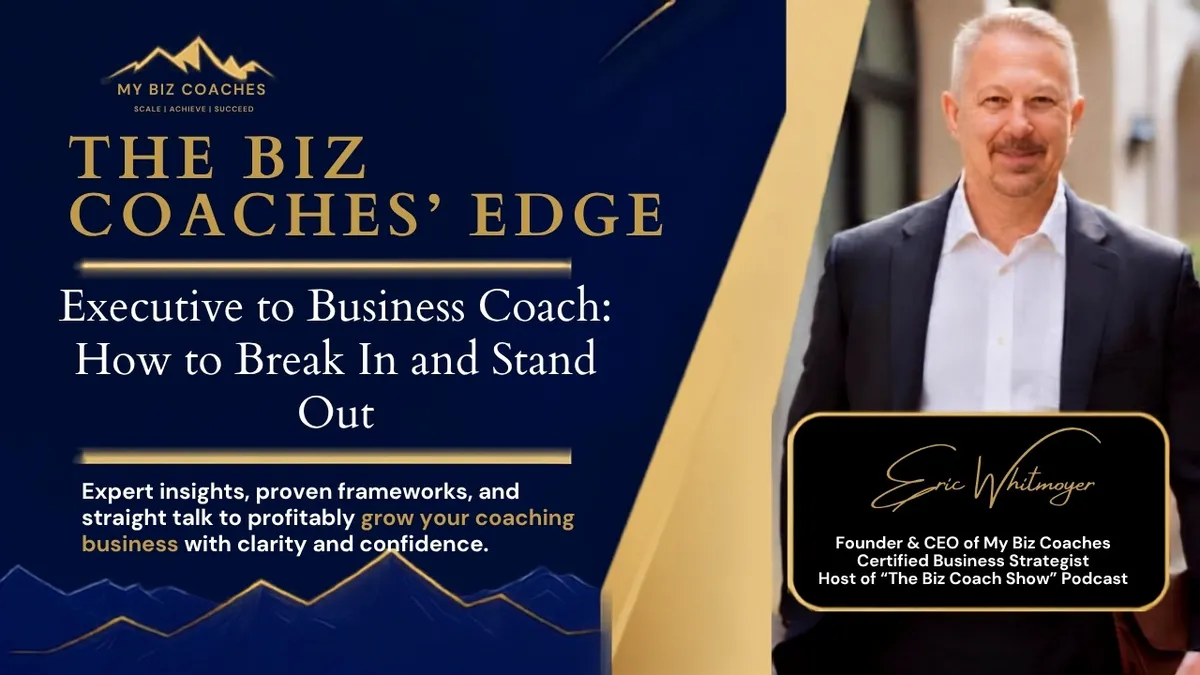
Executive to Business Coach: How to Break In and Stand Out
Microsoft just offered buyouts to about 60,000 people.
Some of them already have a plan. "I've led teams for 20 years. Coaching should be easy."
I hear some version of that every time a wave of layoffs hits. The experience is real. The assumption isn't.
Here's the short answer to how to become a business coach in 2027. Thousands of experienced leaders will try coaching and consulting next year. The ones who succeed will pick a narrow niche, prove results with small business owners, and work from a framework instead of improvising. The rest of this edition shows you how, new or already coaching.
Why are so many executives moving into coaching?
According to CNBC, Microsoft offered voluntary buyouts to roughly 60,000 employees in late October, about 27% of its workforce, including executives.
Challenger, Gray & Christmas counts more than 120,000 AI-attributed job cuts so far in 2026, making AI the top stated reason for layoffs this year.
Many of those leaders won't go back to a corporate job. They'll go independent: coaching, consulting or fractional work. Their reasons are good ones. Flexibility, meaning, and the chance to put decades of experience to work on their own terms.
Most will start in the Creator phase ($0 to $100K) of their own practice. Plenty will stall there or in the Hustler phase ($100K to $250K), because the skills that run a corporate team are not the skills that win clients.
For established coaches, that's new competition. For small business owners, it's a deeper bench. For the profession, it raises the bar.
What I learned going from executive to coach
I spent 25 years as a wireless retail executive. I led top-performing sales teams, managed hundreds of employees, and played a significant role in an almost 9-figure exit in 2017.
None of that told me what to charge my first coaching client.
I had no idea. I'd spent decades as the "Cleaner," the guy sent in to turn around underperforming stores and markets. That turnaround skill turned out to be exactly what owners would pay for. But I had to learn to sell it to a 12-person company, in their language, at their budget.
That's the gap I see in almost every executive who comes to coaching. I've worked with 30+ coaches, consultants and fractional executives over the last five years. The talent is never the problem. The translation is.
The three mistakes new coaches make
The coaches who struggled early almost always made one of these:
1️⃣ Coaching everyone. "I help businesses grow" isn't a niche. Owners hire the coach who sounds like they already understand their exact problem.
2️⃣ Selling corporate solutions to small businesses. A 10-person company doesn't need a 40-page strategy deck. It needs three priorities and someone to hold them accountable.
3️⃣ Improvising every session. Without a framework, every engagement starts from scratch. Clients can't see progress, and the coach can't scale.
How to become a business coach owners actually hire: niche by industry plus phase
The fastest way to stand out is Sales & Marketing basics: combine an industry you know with the phase of scale you serve best.
✳️ "I help home service companies between $250K and $1M build the team that replaces the owner."
✳️ "I help ABA practice owners in the Hustler phase build systems before they hire."
✳️ "I help law firms in the Operator phase fix billing and collections."
A narrow niche feels risky. It's the opposite. It makes you easy to refer, easy to find and easy to remember.
Phase fluency is also what makes the advice land. What saves an Operator can sink a Creator.
Authority beats credentials
Owners don't hire a title. They hire proof. Three ways to build it fast:
1️⃣ Publish. A book, a newsletter, a podcast. Today's post on free audiobook narration shows how cheap authority just got.
2️⃣ Show small wins. Two or three client results beat a long resume. Across our clients, roughly 35% jump at least one phase per year. Coaches who deliver measurable phase jumps don't struggle for referrals.
3️⃣ Use a named framework. Ours are the 7 Core Competencies and the 8 Phases of Scale from The CEO's Playbook for Scale. A framework shows clients where they are and where they're going.
✅ Do: write a one-line niche statement this week: who, which phase, which result
✅ Do: pick one framework and use it with every client
❌ Don't: compete on price against the new wave
❌ Don't: assume your corporate title will sell for you
➡️ The coaches who win in 2027 won't be the most experienced. They'll be the most specific.
What this looks like as your practice scales
At Creator ($0 to $100K), your job is proof. Get three clients results and document them.
At Hustler ($100K to $250K), your niche starts referring for you. Say no to work outside it.
At Operator ($250K to $500K), you need systems: a framework, a delivery process and maybe your first associate coach.
At Leader ($500K to $1M), you stop being the only coach. Your job becomes building the bench.
A Question for You
If a business owner described your coaching to a friend in one sentence, what would they say, and is that the sentence you want?
Quick Answers
How do I become a business coach after a corporate career? Pick a narrow niche that combines an industry you know with a phase of scale you serve best, then prove results with a few small business clients before you scale. Corporate experience is an asset, but owners hire coaches who speak their language and show proof, not titles.
How should a new business coach choose a niche? Combine an industry you understand with the phase of scale you serve best, such as home service companies between $250K and $1M. In the 8 Phases of Scale, each phase has different problems, so a phase-specific niche makes your message sharper and referrals easier.
Do business coaches need a framework or certification? A framework helps clients see where they are, what to fix next and how progress is measured, and it lets a coach deliver consistent results and train others later. My Biz Coaches certifies coaches on the 7 Core Competencies and the 8 Phases of Scale through a licensing model rather than a franchise.
Your Next Steps
✳️ Explore becoming a Certified My Biz Coach: If you're weighing your path into coaching, there are three: go it alone, buy a franchise, or license a proven system. Our licensing model gives you the framework, tools, brand, marketing support and a community of about 25 Coach Partners, without franchise-level cost or restrictions. Take a look and decide if it fits.
✳️ Free conversation with Eric: Making the move from corporate, or trying to sharpen your niche? Let's talk it through.
✳️ Take the free My Biz Navigator: Use it with your own clients to find their phase and weakest competency in 5 minutes. The Small Business Survival Guide ([SURVIVAL GUIDE LINK]) works the same way as a first-session tool.
Sincerely,
Eric T. Whitmoyer, Business Growth Strategist
Founder & CEO at MyBizCoaches.com
Host of The Biz Coach Show
From Startup to Exit, We're There for Your Biggest Decisions
P.S. Curious where your business really stands? My Biz Navigator is a free 5-minute assessment that shows you exactly what's working and what it's quietly costing you.
Take it here → www.MyBizNavigator.com
Because the difference between ordinary and extraordinary isn't luck; it's the information you act on.