
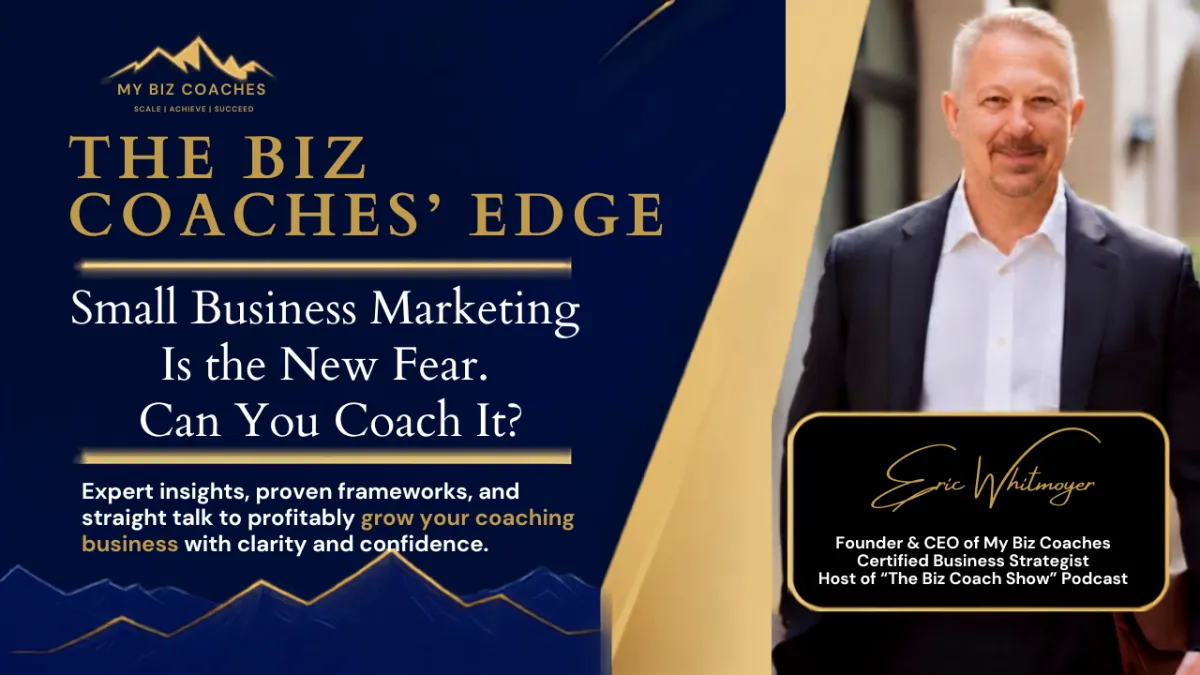
Small Business Marketing Is the New Fear. Can You Coach It?
Owners used to call me about cash. Now they call about leads.
Same panic in their voice. Different problem.
Small business marketing has climbed into the top tier of what keeps owners up at night in 2026, right alongside rising costs and finding good people. If you work as a business coach, business consultant, or fractional executive, that's your opening. It's also your test. Owners who are scared of their marketing need someone who can make it make sense, and before they hire you, they'll quietly check whether your own marketing works.
Why Is Small Business Marketing Suddenly a Top Concern?
Look at how owners are spending their money.
According to Constant Contact's Q1 2026 Small Business Now report, a survey of more than 1,500 small business owners found that 41% named inflation and rising costs as their top concern. Yet 68% expect their marketing budgets to increase this year, and 74% expect to spend more time on marketing.
Sit with that for a second. Costs are squeezing them from every direction, and they're still putting more dollars and more hours into marketing. Owners don't do that with something they feel confident about. They do it when they're afraid standing still means falling behind.
And most of them are guessing. More channels than ever. AI tools promising the moon. No clear way to tell what's working. That fear is rational.
Where Marketing Fear Peaks: The Hustler and Operator Phases
In the 8 Phases of Scale, marketing fear shows up hardest in one specific spot.
The Hustler phase ($100K–$250K) runs on the owner. Referrals, relationships, and the owner's personal energy. Marketing is whatever the owner did last Tuesday. It works right up until the owner gets busy delivering, and then the pipeline dries up.
The Operator phase ($250K–$500K) needs something the Hustler never built: a marketing system that runs whether the owner shows up or not. A defined ideal client. One clear message. A few channels, measured every month.
The gap between those two phases is where owners stall. It's also where most coaching practices stall.
Here's the uncomfortable truth. Most solo coaches live in the Hustler phase of their own practice. Clients come from their network, a few referrals, a LinkedIn post that happened to land. They sign three clients, get busy coaching, stop marketing, and ninety days later they're staring at an open calendar. Feast, then famine.
You can't credibly coach an owner out of the Hustler marketing trap while you're living in it.
What a Gym Full of Champions Taught Me About Marketing
Years ago I owned a martial arts gym. I was a champion kickboxer, and I trained local and regional champions out of that building. I figured that would fill the mats.
It didn't. That first winter we had fewer paying members than heavy bags.
What changed things was boring. We picked one audience: parents who wanted their kids to learn discipline. We wrote one message for them. We ran a free trial class every Saturday morning and tracked sign-ups on a whiteboard by the front desk. Within months, the whiteboard, not my fight record, was what grew the gym.
Great coaching didn't market itself. It never does.
I've watched the same pattern across the 30+ coaches, consultants, and fractional executives I've worked with over the last five years. The most talented coach in the room is rarely the busiest one. The busiest one has a system and knows their numbers.
How to Coach Marketing When Your Clients Are Afraid of It
1️⃣ Diagnose the phase before you prescribe. A Hustler-phase owner needs one channel and one message. An Operator-phase owner needs a system, a budget, and a monthly scorecard. Hand a Hustler the Operator playbook and you'll bury them.
2️⃣ Turn the fear into five numbers. Leads, conversion rate, cost to acquire a client, average client value, and time to close. Once an owner sees those every month, marketing stops being a mystery and becomes a management problem. Owners know how to manage.
3️⃣ Fix the message before the channel. Owners want to talk about TikTok and AI ads. Most of their problem is that nobody, including them, can explain what they do in one sentence.
4️⃣ Run the same system in your own practice. Know your own five numbers. If you can't say how many conversations it takes you to sign one client, start there this week.
✅ DO position yourself as the person who makes marketing measurable.
✅ DO use your own pipeline numbers as proof you practice what you coach.
✅ DO build a monthly marketing review into every client engagement.
❌ DON'T pretend to be a marketing agency. Owners need a strategist and a scorecard; specialists can handle execution.
❌ DON'T count on referrals to fill your calendar. They're a bonus, not a plan.
❌ DON'T critique a client's pipeline you couldn't defend in your own practice.
➡️ Marketing fear goes away the day an owner can finally see the numbers.
A Question for You
If a prospective client asked you tomorrow how you get your own clients, what would you honestly say? And would that answer make them want to hire you to fix their marketing?
Quick Answers
Why are small business owners so worried about marketing in 2026? Costs are rising and customers are harder to reach, yet owners feel pressure to spend more to keep up. Constant Contact's Q1 2026 Small Business Now report found 41% of owners named inflation and rising costs their top concern, while 68% expect their marketing budgets to increase and 74% expect to spend more time on marketing. Most still lack a clear way to measure what's working.
How do business coaches get clients consistently? Coaches who get clients consistently run a marketing system instead of relying on referrals alone: a defined ideal client, one clear message, a few measured channels, and monthly pipeline numbers. In the 8 Phases of Scale, this is the shift from the Hustler phase ($100K–$250K) to the Operator phase ($250K–$500K) of a coaching practice.
Does a business coach need to be a marketing expert? A business coach needs enough Sales & Marketing competency to diagnose, measure, and prioritize, not necessarily to run campaigns. The strongest coaches help owners set targets and read their marketing numbers, then bring in specialists for execution. Coaches in the My Biz Coaches network use shared frameworks and tools, so they don't have to build this from scratch.
If This Hit Close to Home
Start with the 2026 Business Survival Guide. It walks through the marketing, pricing, and financial discipline that separates a Hustler-phase practice from an Operator-phase one. Use it on your own practice first, then put it in front of the clients who are losing sleep over their marketing. It's free. Download the Guide here.
If your own pipeline still runs on referrals and good luck, let's talk it through. Reach out for a free conversation this week and we'll map the marketing system your practice needs to reach the Operator phase.
And if you'd rather not build that system alone, the Certified My Biz Coach business coaching license is the practical coaching franchise alternative: proven tools, brand, marketing support, and a community of 25 Coach Partners, without the six-figure investment and restrictions of a franchise. Learn more at MyBizCoaches.com.
To Your Success,
Eric T. Whitmoyer, Business Growth Strategist
Founder & CEO at MyBizCoaches.com
Host of The Biz Coach Show
From Startup to Exit, We’re There for Your Biggest Decisions
P.S. If you’re serious about taking your business to the next level, then you may find value in getting a copy of our 2026 Business Survival Guide, full of strategies, tactics, and solutions to help move your business forward faster this year.
Because the difference between ordinary and extraordinary isn’t luck; it’s the information you act on.
Consider becoming a Certified My Biz Coach – Learn More HERE.