

Start Measuring and You'll Find Out Who's Coasting
Where this shows up
It shows up the first time you can't see everyone's work.
In the Operator phase ($250K to $500K), you sit next to the team. You know who's carrying the load because you watch it happen.
Then you cross into the Leader phase ($500K to $1M). You add a manager, a remote contractor, a virtual assistant. You stop seeing the work. You see results, late, and you guess at the rest.
Most small business owners were never taught to set expectations in writing. We hired people we liked and assumed they knew what "good" looked like.
Gallup says most of them don't.
Why this matters more going into 2027
In Saturday's Biz Coach Insider, "Winter Is Coming," I laid out the slowdown signals and one simple rule: strengthen the phase you're in before you push to the next one.
Your team is the first place to apply it.
When revenue is easy, a coasting role hides inside the growth. When revenue tightens, every seat has to earn its place. You want to find out who's coasting now, while you have time to coach, not in March when you're forced to cut.
What happened when I started tracking
This month we started tracking hours and output for a contractor on my own team.
Within a couple of weeks, the quality of the work and the communication both dropped. [CONFIRM: add one detail, such as the role, what slipped, and what you did next.]
My first reaction was frustration. My second was the right one: the tracking didn't cause the problem. It showed me a problem I'd been paying for without seeing.
I learned the same thing over 30 years as the person sent in to fix underperforming stores and regions. Almost every turnaround started with a simple question nobody had asked: what exactly is this person supposed to produce each week?
What the 2026 data confirms
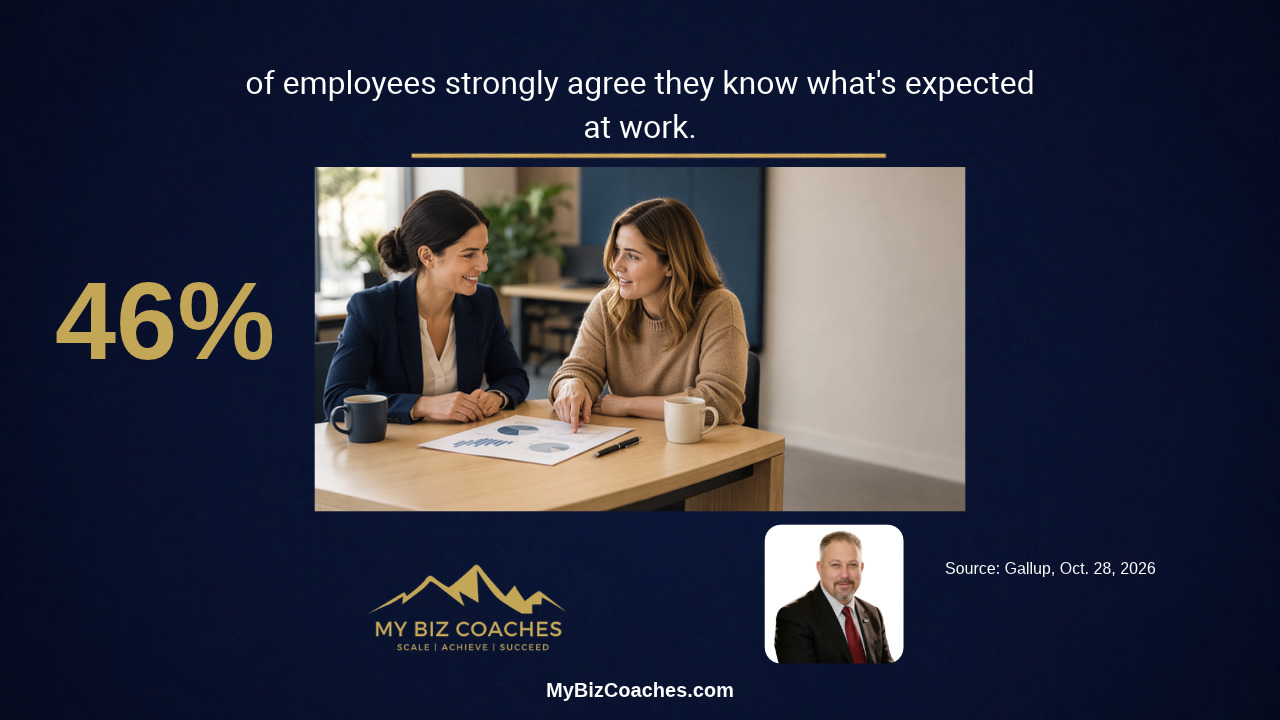
✳️ Only 46% of U.S. employees strongly agree they know what's expected of them at work, down 3 points in Q3 2026 (Gallup, Oct 28, 2026).
✳️ U.S. employee engagement fell to 29% in Q3 2026, the lowest since 2011 (Gallup, Oct 28, 2026).
✳️ Actively disengaged employees rose to 18% (Gallup, Oct 28, 2026).
➡️ If more than half your team isn't sure what's expected, you're not managing performance. You're hoping for it.
The insight
1️⃣ Measure output, not activity. Hours tell you someone was present. Output tells you something got done. Track both at first, then keep the output number.
2️⃣ Write the expectation before you measure it. If the number surprises the employee, you skipped a step.
3️⃣ The first 30 days are for coaching, not firing. Most people improve once they can see the target. The ones who don't are your real decision.
✅ To Do:
✅ Write one output number for every role on one page
✅ Share it with each person before you start tracking
✅ Review it weekly in a 15-minute one-on-one
✅ Talk within 3 days when a number slips
✅ Recognize the people who hit it, in writing
✅ Measure yourself the same way
❌ Don't Do:
❌ Don't start tracking without explaining why
❌ Don't measure 10 things; pick one
❌ Don't wait for the annual review to raise a slip
❌ Don't assume a drop means bad intent; ask first
❌ Don't keep paying for a role nobody can define
What this looks like as you scale
In the Operator phase ($250K to $500K), you set the numbers yourself and review them with each person.
In the Leader phase ($500K to $1M), your managers own the weekly reviews. What you have to let go of: being the only one who knows how everyone is doing.
In the Architect phase ($1M to $3M), the numbers roll up into a team scorecard you read in 10 minutes a week.
Coaches building a practice face the same shift. The first time you bring on a second coach or a VA, define their output before you hand them a client.
Reflective questions
Could every person on your team tell you, in one sentence, what they're expected to produce this week?
And if you asked them tomorrow, would their answer match yours?
Quick Answers
How do I measure employee performance in a small business? Give each role one clear output number, write it down, and review it in a 15-minute weekly one-on-one. Gallup found only 46% of U.S. employees strongly agree they know what's expected of them, so clarity comes before measurement.
Will tracking hours make my employees feel micromanaged? It can if you start without explaining why. Share the number first, review it together, and move to output measures once trust is built; this is core People Management.
When should a small business owner hand off performance reviews to a manager? As you move from the Operator phase ($250K to $500K) into the Leader phase ($500K to $1M) in the 8 Phases of Scale. A My Biz Coaches business coach can help you build the scorecard first.
Your next steps
✳️ Become a Certified My Biz Coach: This week's focus. If you've spent a career setting expectations and developing people, that's exactly what owners need. And if you're in your 50s and facing a layoff or buyout, as we covered in Saturday's Insider, this is a path worth a conversation.
✳️ Get more insight like this to prepare for 2027: Subscribe to The Biz Coach Insider, where "Winter Is Coming" ran on Saturday → https://bit.ly/BizCoachInsider
✳️ Free leadership coaching session: Bring one role you can't define and leave with its output number.
✳️ Take the free My Biz Navigator: See how your People Management scores against the other 6 Core Competencies in about 5 minutes.
Sincerely,
Eric T. Whitmoyer, Business Growth Strategist Founder & CEO at MyBizCoaches.com Host of The Biz Coach Show From Startup to Exit, We're There for Your Biggest Decisions
P.S. Curious where your business really stands? My Biz Navigator is a free 5-minute assessment that shows you exactly what's working and what it's quietly costing you.
Take it here → www.MyBizNavigator.com
Because the difference between ordinary and extraordinary isn't luck; it's the information you act on.