
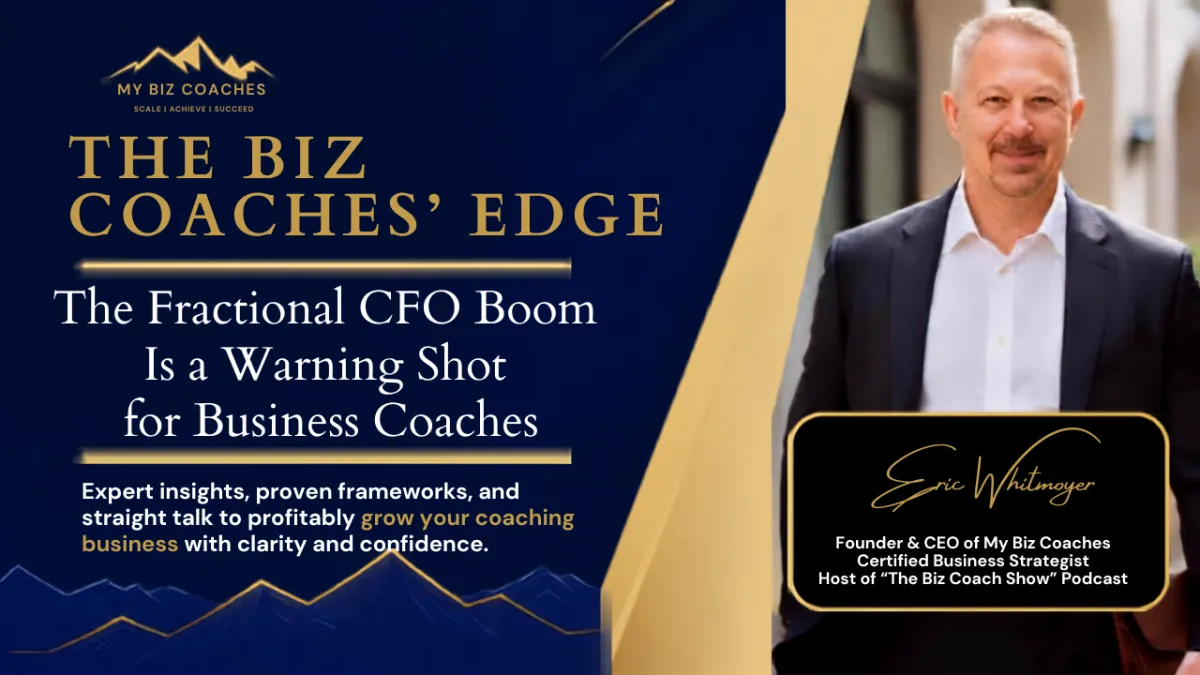
The Fractional CFO Boom Is a Warning Shot for Business Coaches
Fractional CFO vs Business Coach: Who Gets the Client?
Your client's next hire probably isn't you.
It's a fractional CFO.
Owners are paying part-time finance leaders to run their numbers, set their targets, and tell them what to do next. That used to be coaching territory. In the fractional CFO vs business coach question, owners don't pick a side. They hire the people who make the numbers lead somewhere. If you're a business coach, business consultant, or fractional executive who goes quiet when the conversation turns to money, you're the one who gets replaced.
Is the Fractional CFO Boom Real?
Yes, and the data is hard to argue with.
According to Lightcast, there were 677 job postings for fractional roles in 2025. In the first seven months of 2026, there were nearly 1,000. That's more than all of last year, in just over half the time.
Finance made up 46% of fractional postings in the US, and Chief Financial Officers were by far the largest single occupation. Lightcast also found that 97% of 2026 fractional postings came from small and medium-sized companies, not the Fortune 1000.
Postings are one lens, not the whole market. But the direction is clear. Small business owners want financial leadership without a full-time salary, and they're getting it.
Where Does This Hit a Coaching Practice?
In the 8 Phases of Scale, owners start reaching for real financial leadership in the Operator phase ($250K–$500K) and the Leader phase ($500K–$1M). Bookkeeping stops being enough. Cash timing, margins, pricing, and hiring decisions all get expensive when they're wrong.
A Creator-phase owner ($0–$100K) doesn't need a CFO. They need a bookkeeper and a simple budget. Hand them a CFO-level playbook and you'll bury them. Knowing the difference is phase fluency, and it's what makes a coach worth hiring.
Your own practice follows the same arc. Most solo coaches live in the Creator and Hustler ($100K–$250K) phases. Getting to Leader is hard enough. Then the Architect phase ($1M–$3M) forces a decision: stay a one-person service, or add capability through partners, products, or a team.
That decision is where the CFO boom lands. The owner who used to call you for everything now has a CFO for the numbers. You either work alongside that person or get squeezed out of the money conversation.
What a $6 Million Trucking Company Taught Me About Numbers
I scaled a trucking business to $6M and 27 trucks in under a year.
Every morning I could tell you our truck count. I could not tell you our cash position with any confidence. Customers paid slowly. Drivers, fuel, and insurance did not wait.
Growth hid the problem. Revenue looked great right up until the bank balance didn't.
The best move I made was putting someone next to me who read the financials every week and said the uncomfortable parts out loud. That person didn't replace my judgment. They gave it better information.
Your clients need the same thing. And you can't coach Financial Acumen you don't practice yourself.
How Should a Business Coach Respond?
1️⃣ Learn your own five numbers cold. Revenue per client, client retention, pipeline conversion rate, hours sold versus hours available, and cash runway. If you can't recite them, you're not ready to coach a client's.
2️⃣ Learn to read a P&L, balance sheet, and cash flow statement. You're not doing the books. You're asking sharper questions than the owner has heard before.
3️⃣ Build a referral partnership with a fractional CFO. They bring the technical depth. You bring the decisions, accountability, and follow-through across all 7 Core Competencies. Owners get better results with both.
4️⃣ Use technology to stay fast. KPI dashboards and AI forecasting tools make a monthly financial review a 30-minute conversation instead of a spreadsheet project. Compete on insight, never on bookkeeping.
The supply side matters too. The 2025 ICF Global Coaching Study counted a record 122,974 coach practitioners worldwide, up 15% from 2023. More coaches are chasing the same owners. Generic coaching is getting easier to find and harder to charge for.
✅ DO ask every new client who handles their financials today.
✅ DO get a fractional CFO into your referral circle before you need one.
✅ DO track your own practice numbers monthly, out loud, with a partner or peer.
❌ DON'T give tax or accounting advice. Know your lane.
❌ DON'T treat the CFO as a competitor. Owners hire both when both are good.
❌ DON'T wait for a client to mention a CFO before you learn the language.
➡️ Owners don't choose between the coach and the CFO. They choose the people who make the numbers lead somewhere.
A Question for You
When was the last time a client asked you a money question you couldn't answer? And what did you do about it?
Quick Answers
What is the difference between a fractional CFO and a business coach? A fractional CFO is a part-time finance executive who owns forecasting, cash management, and financial reporting. A business coach guides the owner's decisions, leadership, and execution across areas like Financial Acumen, Sales & Marketing, and People Management. The strongest results often come from using both.
Will fractional CFOs replace business coaches? No, but they will take over the financial conversation from coaches who can't hold it. Lightcast found finance made up 46% of US fractional job postings, with CFOs the largest single role. Coaches with real Financial Acumen can partner with fractional CFOs instead of competing with them.
How can a business coach grow beyond trading hours for dollars? Most coaches move from the Leader phase ($500K–$1M) to the Architect phase ($1M–$3M) by adding partners, products, or a network instead of more hours. A business coaching license like Certified My Biz Coach provides tools, brand, and community so you don't have to build every piece alone.
If You're Weighing Your Next Move
You have three paths into this market: build alone, buy a coaching franchise, or license. The Certified My Biz Coach business coaching license is the practical coaching franchise alternative. You get proven systems and tools, the My Biz Coaches brand, marketing support, and a community of 25 Coach Partners, without the six-figure investment and restrictions of a franchise. If that fits where your practice is headed, learn more at MyBizCoaches.com.
If you're not sure which move fits, let's talk it through. Reach out for a free conversation this week and we'll map your Leader-to-Architect decision: partner, add a financial offer, or stay focused.
And take My Biz Navigator for your own practice first. Then put it in front of the clients who keep telling you they need a CFO. It shows both of you where the numbers are quietly costing you.
To Your Success,
Eric T. Whitmoyer, Business Growth Strategist
Founder & CEO at MyBizCoaches.com
Host of The Biz Coach Show
From Startup to Exit, We’re There for Your Biggest Decisions
P.S. If you’re serious about taking your business to the next level, then you may find value in getting a copy of our 2026 Business Survival Guide, full of strategies, tactics, and solutions to help move your business forward faster this year.
Because the difference between ordinary and extraordinary isn’t luck; it’s the information you act on.
Consider becoming a Certified My Biz Coach – Learn More HERE.