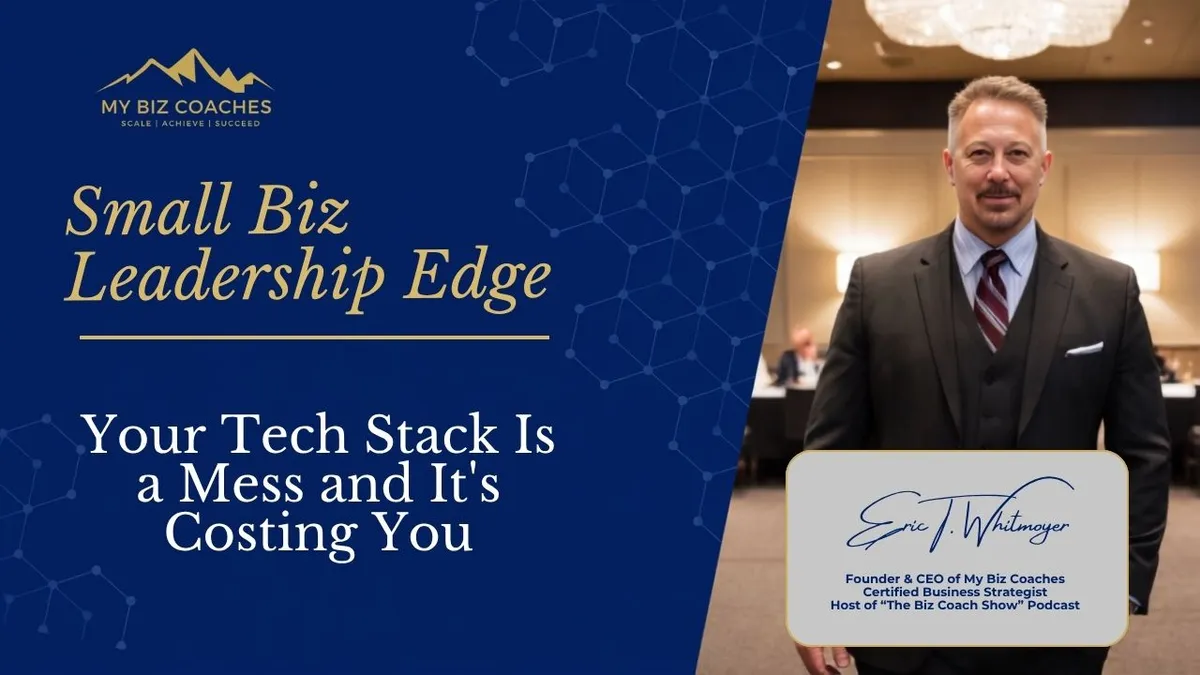
Your Tech Stack Is a Mess and It's Costing You
"We just need the right software."
I hear it almost every week. Here's the short answer on fixing a small business tech stack: stop buying and start deciding. Too many software tools are rarely a technology problem. It's a leadership problem. Owners buy software to fix what people and process should fix, then wonder why nobody uses it.
Competency: Innovation & Technology / Operational Excellence Phase of Scale: Operator → Architect ($250K–$3M)
Where this shows up
A couple of years after my partner and I bought that first wireless store, we were opening locations fast. Somewhere around store six, I decided our problems were software problems.
So in one quarter we added a scheduling app, a customer follow-up CRM, a commission tracker, and an inventory add-on that was supposed to talk to our point-of-sale system. Four tools. Every store. All at once.
Ninety days later I walked into the back office of one of our busiest stores. The manager had the schedule on a whiteboard, commissions in a spiral notebook, and follow-up calls on sticky notes around the edge of his monitor. The CRM had 11 customers in it.
I was mad for about ten minutes. Then I realized I'd done it to him. Nobody had decided what problem each tool was supposed to solve. Nobody owned the rollout. I'd handed busy store leaders four new jobs and called it progress.
We cut two of the tools. We rolled out the scheduling app one store at a time, with one manager owning it. The CRM came 60 days later. Adoption followed. By store ten, new managers learned two systems, not six.
That's the pattern. In the Operator phase ($250K–$500K), you buy tools to replace the hires you can't afford yet. In the Leader phase ($500K–$1M), every department head picks their own app and nothing connects. By the Architect phase ($1M–$3M), you're paying for a stack nobody fully uses, and your numbers live in five places that disagree with each other.
What does the data say about software overload?
✳️ Nearly half. Nexthink analyzed 6.12 million employee devices and found almost half of installed software and licensed SaaS apps went unused, as reported by TechRepublic in 2023. That's money leaving every month for tools nobody opens.
✳️ 56%. In a Gartner survey of nearly 5,000 technology users, 60% said new software had frustrated them in the past two years, and 56% said it made them wish management would bring back the old system. After a bad experience, 40% pushed back by using minimal features, avoiding the app, or delaying.
✳️ 170+ clients. Across 170+ clients over 7 years, I've never seen a business jump a phase of scale because of a new app. I've seen plenty jump after the owner got clear on the process and who owns it.
➡️ Your team isn't resisting technology. They're resisting change nobody led.
Why does buying software feel like leading?
1️⃣ It feels like action. A purchase takes five minutes. A real conversation about how work flows through your business takes an afternoon and some honesty. The credit card wins.
2️⃣ You're automating a mess. If your sales follow-up lives in one person's head, a CRM just gives that mess a login. Software scales whatever process you already have. Good or bad.
3️⃣ Everyone changes everything at once. New tools in every department in the same quarter guarantees overload. People default to what they know. Usually the whiteboard.
To Do
✅ List every tool you pay for, what it costs a month, and who actually logs in. One afternoon. One spreadsheet
✅ Write the process on one page before you shop for anything
✅ Give every tool one owner, accountable for training, adoption, and results
✅ Roll out one tool at a time, in one team first, for 30 to 60 days
✅ Ask your team "what do we actually need?" before you ask a vendor
✅ Cancel anything nobody has opened in 90 days
Don't Do
❌ Buy software to avoid a hard conversation about a person or a process
❌ Launch new tools in every department in the same month
❌ Let each manager pick their own app with no plan for where the data lives
❌ Judge a tool by the demo. Judge it by 90 days of real use
❌ Keep paying for something "because we might use it"
What this looks like as you scale
Operator ($250K–$500K): Keep it lean. A handful of core tools for money, customers, and communication. Your one-page process docs matter more than your apps.
Leader ($500K–$1M): Have your first manager own one system end to end. That's leadership development and tech adoption in the same move.
Architect ($1M–$3M): Run a quarterly stack review. Every tool earns its seat or loses it. Decide where the single source of truth lives for customers, money, and work.
Optimizer ($3M–$10M): Now integration matters. You'll likely need someone, internal or fractional, who owns the whole stack. The leadership that got you here, buying fast, won't get you there.
Coaches, same trap. A practice in the Hustler phase doesn't need a funnel builder, three schedulers, and a course platform. It needs clients and a repeatable way to serve them.
Reflective questions
If you canceled every tool nobody opened last month, what would you actually lose?
What problem are you trying to buy your way out of that's really a conversation you haven't had yet?
Quick Answers
How many software tools does a small business need? Fewer than most owners have. Start with the core: money, customers, communication, and work management. Write the process on one page first, then make every tool earn its place with real use.
Why won't my employees use the new software? Usually because nobody led the change. Tools rolled out across every department at once, with no clear owner and no clear problem to solve, stall. Roll out one tool at a time, with one owner, in one team first.
When should a small business invest in more technology? When a documented process works and volume is outgrowing it. In the 8 Phases of Scale, integration usually starts to matter in the Architect phase ($1M–$3M). My Biz Coaches helps owners decide what to keep, cut, and add as part of leadership coaching on Innovation & Technology.
Want to clean up your own stack?
✳️ Start on your own. Take the free 5-minute Biz Navigator or grab the Survival Guide at MyBizNavigator.com. It shows where your operations and technology are quietly costing you.
✳️ Free coaching session. Book one here. We'll walk your stack, find the tools nobody owns, and map what to cut first. That's how My Biz Coaches works: your real business, clear direction.
✳️ Become a Certified My Biz Coach. Help owners lead through exactly this kind of decision and build a coaching practice of your own. Start at MyBizCoaches.com/Coach.
Sincerely,
Eric T. Whitmoyer, Business Growth Strategist
Founder & CEO at MyBizCoaches.com
Host of The Biz Coach Show
From Startup to Exit, We're There for Your Biggest Decisions
P.S. Curious where your business really stands? My Biz Navigator is a free 5-minute assessment that shows you exactly what's working and what it's quietly costing you.
Take it here → www.MyBizNavigator.com
Because the difference between ordinary and extraordinary isn't luck; it's the information you act on.