Join the Biz Coach Insider Newsletter
Weekly insights for founders serious about scaling — delivered to your inbox.
Biz Coach Insider
A Weekly Newsletter by Eric of My Biz Coaches
Weekly dedicated insights for entrepreneurs and business leaders committed to growth, strategy, and mastery.

Blogs
Biz Coach Insider+ - Thirty Eighth Edition
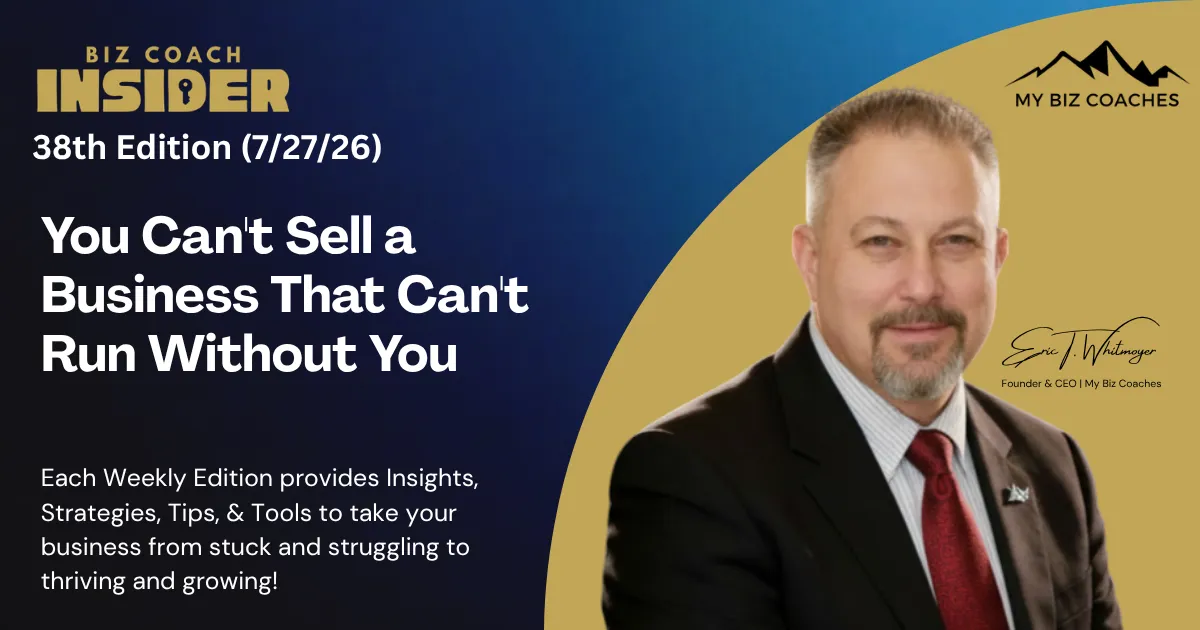
Biz Coach Insider - 38th Edition (7/27/26) - You Can't Sell a Business That Can't Run Without You
I have shared this sobering statistic many times since uncovering it about 5 years ago. 80% of businesses that list their business to sell, never sell. In fact, 92% of all small businesses close and only 5% ever actually sell. The rest limp to some other ending nobody talks about at conferences.
I've sat across the table from owners who built something real. $2M. $5M. $12M in revenue. And when I ask what happens if they get hit by a bus tomorrow, they go quiet. Not because they haven't thought about it. Because they have, and they don't like the answer.
McKinsey is projecting close to $5 trillion in baby-boomer-owned businesses will change hands by 2035. Six million companies. Only about a million of them are viable candidates for a sale. The rest are heading toward closure, fire-sale liquidation, or just quietly shutting the lights off.
Here's the part that should keep you up at night. That gap between "viable" and "not viable" isn't about revenue. It's about whether the business needs you to survive.
✳️ A business that depends on you isn't an asset. It's a job you can't quit.
Why buyers walk
I've been on both sides of this. I've built businesses, scaled them, and exited near a 9-figure deal in wireless retail. I've also sat in diligence meetings where a buyer's team pulled apart a seller's story in about 40 minutes.
Here's what kills a deal, or guts the price, every time:
❌ The owner is the top salesperson and nobody else can close
❌ Pricing, vendor terms, and key relationships live in the owner's head
❌ There's no leadership layer, just the owner and a group of task-doers
❌ Systems and processes exist as tribal knowledge, not documentation
❌ Customers call the owner directly because that's "how it's always worked"
A buyer isn't purchasing your revenue. They're purchasing a repeatable, transferable engine. If that engine stalls the moment you walk out the door, you don't have a business. You have a very demanding client called "your company."
Where this shows up by phase
This problem doesn't appear the same way at every stage. It changes shape as you scale, and ignoring it gets more expensive every year you wait.
1️⃣ Architect ($1M–$3M): This is where founder-dependency gets baked in or broken. You're past pure survival mode, but most owners here are still the head of sales, the head of ops, and the head of everything else. What you must let go of: the belief that you're the only one who can do it right. Start documenting the decisions only you currently make.
2️⃣ Optimizer ($3M–$10M): You've hired people, but have you hired leaders? Most Optimizer-stage owners have delegated tasks, not authority. The business still can't make a decision without you in the room. What you must let go of: control over the how. Build leaders who own outcomes, not just checklists.
3️⃣ Executive ($10M–$25M): By now the systems either exist or they don't. If they don't, this is where enterprise value gets capped hard. Buyers and investors at this range run real diligence. What you must let go of: being the smartest person in every meeting. Your job is building the team that makes you replaceable in the org chart, not replaceable in importance.
4️⃣ Investor ($25M–$100M): At this stage, the business should run whether you're in Aspen or in the office. If it doesn't, you don't have a company worth $25M-$100M. You have a really well-paid job with a big number attached to it. What you must let go of: the identity of being "the business." You are the steward of an asset now, not the engine running it.
Look at where you sit today. Then ask yourself honestly what would happen if you disappeared for 90 days. If the answer scares you, that's your starting point.
Build it before you need it
This is the whole thesis of my book, The CEO's Playbook for Scale. You have to think and build like a CEO, not an employee of your own company. That means:
✅ Documented processes for every core function, not just the ones you enjoy
✅ A leadership layer with real decision-making authority
✅ Customer relationships tied to the company, not to you personally
✅ Financial systems clean enough that a stranger could read them in an afternoon
✅ A sales engine that doesn't require your face on every call
None of this happens the year you decide to sell. It happens years before, when you're still building. Enterprise value isn't created in the exit conversation. It's created every quarter you choose systems over shortcuts.
I've watched this play out with my trucking business. We scaled to $6M with 27 trucks in under a year. That kind of growth forces the question fast: are we building an operation, or are we building a version of me that happens to own trucks? The businesses that survive that growth curve are the ones that answer that question early.
➡️ Ask yourself this week: if a buyer showed up tomorrow, could your team run the diligence meeting without you in it?
Coaching Corner
If you're a business coach, consultant, or fractional leader, this same math applies to you and it applies to your clients twice.
For your clients: you are not doing them a favor by staying indispensable to their business. The coach who builds a client's dependency on the coach isn't creating transformation. They're creating a second job for the client. Real coaching builds the client's internal capability so eventually they don't need you in the room either. That's the paradox of good coaching. Your success is measured by how replaceable you become.
For your own practice: the same 92% - 5% math applies to you. If your coaching business is just you doing 1:1 sessions, you don't have a business. You have a very well-paying job in your own calendar. I've built a team of roughly 25 Coach Partners precisely because a coaching practice that can't scale past the founder isn't sellable, isn't transferable, and caps out the moment you get tired or sick.
Whatever phase you're in as a coach, from solo practitioner to building a firm, ask the same question you're asking your clients to ask. Can this run without you? If not, you're not building an asset. You're building a really good excuse to never take a vacation.
To Your Success,
Eric T. Whitmoyer, Business Growth Strategist
Founder & CEO at MyBizCoaches.com
Host of The Biz Coach Show
From Startup to Exit, We're There for Your Biggest Decisions
P.S. If you're serious about taking your business to the next level, then it's time to stop figuring it out alone. The Biz Mastery Network was built for owners who want structure, strategy, and real execution support without the noise. It includes The Biz Coach Insider Newsletter, designed specifically for busy business owners who need clarity fast and results faster.
Because the difference between ordinary and extraordinary isn't luck; it's the information you act on.
Consider becoming a Certified My Biz Coach – Learn More HERE.

Get In Touch
Email: [email protected]
Address
Office: 2622 E. Palm Beach Rd.
Assistance Hours
Monday to Saturday - 9:00am to 8:00pm
Sunday - CLOSED
Phone Number:
(623) 294-3795
Empowered Growth With Coaching
Trusted by owners who scaled past $10M and beyond.
© 2026 - All Rights Reserved