
Media
Your go-to source for insights, updates, and conversations that help you grow personally and professionally.
Explore More My Biz Coaches Content

The Biz Coach Show
The Podcast of My Biz Coaches
Get weekly educational videos to help you learn how to scale your business, achieve your goals and experience success in all aspects of your life. Stream it on YouTube, Spotify and Apple Podcasts.
Biz Coach Insider
A Weekly Newsletter by Eric of My Biz Coaches
Weekly dedicated insights for entrepreneurs and business leaders committed to growth, strategy, and mastery.

Blogs
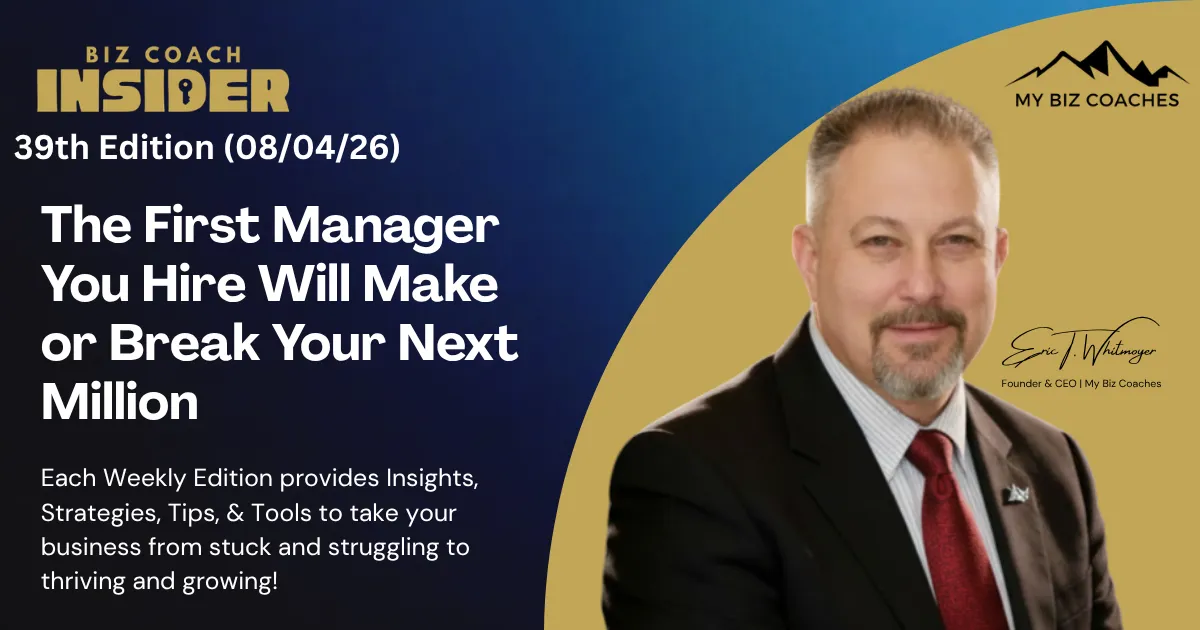
Biz Coach Insider+ - Thirty Ninth Edition
Biz Coach Insider - 39th Edition (8/04/26) - The First Manager You Hire Will Make or Break Your Next Million
You built this business by being the best doer in the room. Best closer. Best technician. Best fixer.
That skill got you to $500K. It will not get you to $3M.
Somewhere between Leader ($500K–$1M) and Architect ($1M–$3M), you stop managing people who do the work. You start managing someone who manages the people who do the work. That's a different job. Most owners hire for it like they're filling any other seat, and it costs them.
✳️ Here's the number that should stop you: 50% of employees who quit do it to get away from their manager. Not the job. Not the pay. The manager.
➡️ And replacing a mid-level manager runs 100% to 150% of their salary once you count the lost productivity, the rehire, the ramp-up, the deals or projects that stall while the seat sits empty.
I've built this seat wrong before. I've also watched clients rush it because the floor was drowning and "someone" needed to be in charge by Monday. A rushed internal quick fix, the person who was just next in line, spikes department turnover 25% to 30% inside a year. The team doesn't trust a title. They trust judgment they've watched hold up under pressure.
Why This Hire Breaks Businesses at This Exact Phase
At Creator and Hustler, you are the standard. Every decision runs through you because there's no one else and not much to decide yet.
As a leader, that stops scaling. You've got a team now, not a crew. The business needs someone who holds the line when you're not in the room. Not a scheduler. Not a senior doer with a new title. Someone who owns outcomes.
Get this wrong at the Leader phase, and you don't just lose a manager. You lose the team's belief that standards mean anything when you're not watching. That belief is expensive to rebuild.
I've seen this exact failure play out in wireless retail, in trucking, in gyms. Different industries, same pattern: Promote the best performer instead of the best leader, and performance drops company-wide within two quarters. The best salesperson doesn't automatically know how to develop other salespeople. The best mechanic doesn't automatically know how to hold a shop accountable. Different skill. Different person, sometimes.
What to Actually Screen For
Résumés tell you what someone did. They don't tell you how someone will hold your standard when it's inconvenient, unpopular, or the customer is yelling.
✅ Do screen for:
Values alignment before skill alignment. Can they hold your standard even when it costs them likability with the team?
Evidence they've corrected someone respectfully and it stuck. Ask for the story, not the theory.
Comfort with being disliked temporarily in service of a result.
Questions that reveal how they think about accountability, not just what they know about the role.
❌ Don't screen for:
Years of experience alone. Experience doing the job is not experience leading the job.
Whether they're liked by everyone on the team already. Popularity and accountability rarely travel together in a first-time manager.
How well they perform under a scripted interview answer instead of a real scenario.
Whether promoting them is the path of least resistance for you this week.
Ask yourself before you hire: would I want a room full of people who lead exactly like this person leads? If the honest answer is no, don't put them in the seat because it's convenient.
Handing Over Authority Without Abdicating It
This is where owners overcorrect. They spend months agonizing over the hire, get someone solid in the seat, then either strangle them with oversight or disappear completely. Both fail.
➡️ Handing over authority means the manager owns the decision. Abdicating means you stop paying attention to whether the standard is actually holding.
1️⃣ Set the standard clearly before you hand it over. Write down what "good" looks like. Don't assume it's obvious.
2️⃣ Give them real authority on people decisions in their area. If every call still routes through you, you haven't actually delegated anything.
3️⃣ Check outcomes, not activity. Watch what the team produces and how they feel about the leadership, not whether the manager is busy.
4️⃣ Correct in private, support in public. If you undercut them in front of the team, you've just taught everyone their authority is fake.
5️⃣ Revisit the fit at 90 days honestly. Some people grow into it. Some don't, and pretending otherwise costs you the team.
Do you know right now, without checking with anyone, whether your standard is actually holding when you're not in the room? If you don't know, that's your answer on whether this seat is filled correctly.
Coaching Corner
If you coach owners, this is one of the highest-leverage conversations you can have with a client at the Leader to Architect line. Most of them are quietly making every people decision themselves and calling it "hands-on leadership." It's actually a bottleneck wearing a good outfit.
Your job here isn't to hand them a hiring template. It's to get them to articulate, out loud, what they've been holding that no one else in the business currently holds. That single question exposes the gap faster than any assessment.
This same pattern shows up in your own coaching business as you scale past your first few clients. The moment you bring on a second coach or a fractional lead to support clients, you face the identical decision: do you hire someone who thinks like you, or someone who can hold your standard without becoming a copy of you? I manage a team of roughly 25 Coach Partners today. The ones who succeed aren't the ones who mimic my style. They're the ones who protect the standard in their own voice.
This is the People Management competency, and it's also Leadership & Vision. You can't teach a client to build a management layer if you haven't built one yourself.
The Book Hook
This exact transition, the moment an owner must stop being the only one who holds the standard, is one of the core inflection points I mapped out in The CEO's Playbook for Scale. The 7 Core Competencies don't max out at the same time. People Management usually breaks first, right here, right when the business can least afford it to.
If you're standing at this line right now, ask yourself one more time: Who in your business, besides you, is currently capable of holding your standard when the pressure is on? If the honest answer is no one, that's this week's project.
To Your Success,
Eric T. Whitmoyer, Business Growth Strategist
Founder & CEO at MyBizCoaches.com
Host of The Biz Coach Show
From Startup to Exit, We're There for Your Biggest Decisions
P.S. If you're serious about taking your business to the next level, then it's time to stop figuring it out alone. The Biz Mastery Network was built for owners who want structure, strategy, and real execution support without the noise. It includes The Biz Coach Insider Newsletter, designed specifically for busy business owners who need clarity fast and results faster.
Because the difference between ordinary and extraordinary isn't luck; it's the information you act on.
Consider becoming a Certified My Biz Coach – Learn More HERE.

Get In Touch
Email: [email protected]
Address
Office: 2622 E. Palm Beach Rd.
Assistance Hours
Monday to Saturday - 9:00am to 8:00pm
Sunday - CLOSED
Phone Number:
(623) 294-3795
Empowered Growth With Coaching
Trusted by owners who scaled past $10M and beyond.
© 2026 - All Rights Reserved