Media
Your go-to source for insights, updates, and conversations that help you grow personally and professionally.
Explore More My Biz Coaches Content
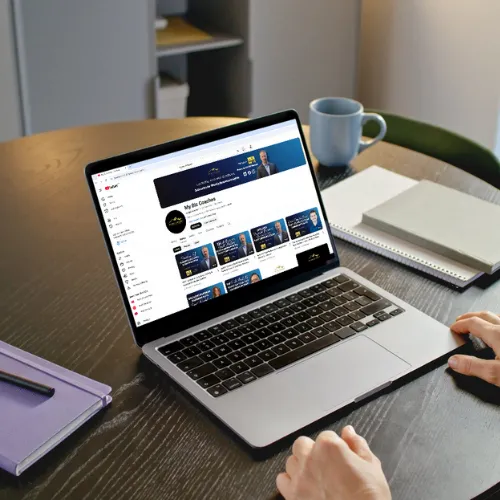
The Biz Coach Show
The Podcast of My Biz Coaches
Get weekly educational videos to help you learn how to scale your business, achieve your goals and experience success in all aspects of your life. Stream it on YouTube, Spotify and Apple Podcasts.
Biz Coach Insider
A Weekly Newsletter by Eric of My Biz Coaches
Weekly dedicated insights for entrepreneurs and business leaders committed to growth, strategy, and mastery.

Blogs
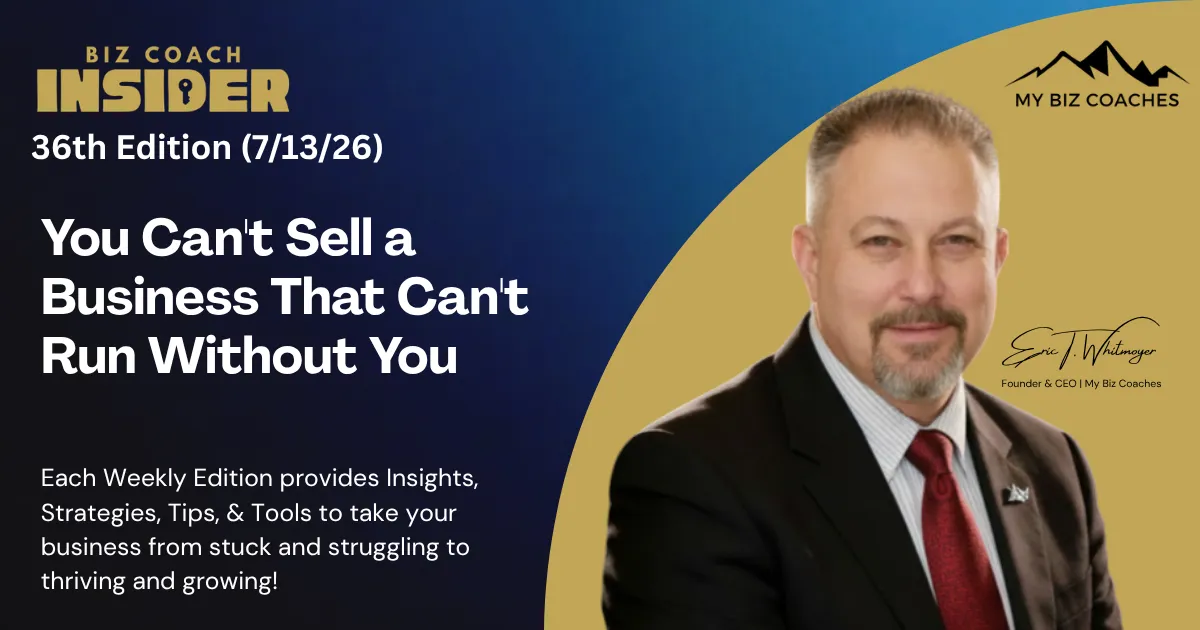
Biz Coach Insider+ - Thirty Sixth Edition
Biz Coach Insider - 36th Edition (7/13/26) - You Can't Sell a Business That Can't Run Without You
Here's the ugliest number in small business.
92%.
That's the share of small-business market exits that happen through closure. Not a sale. Not a handoff. The doors close, the lights go off, and whatever the owner built goes to zero. Only 5% exit through an actual sale. Another 3% get transferred. McKinsey put real numbers behind this in early 2026, and it should stop every owner cold.
Now stack the other number on top of it. Roughly six million small and mid-size businesses will hit an ownership transition by 2035 as boomers retire. Up to $5 trillion in enterprise value coming to market. The biggest wave of businesses changing hands in our lifetime.
Most of them will get nothing for it.
✳️ Here's why, and it has almost nothing to do with the economy. It's because the business can't run without the owner. And a business that can't run without you isn't an asset. It's a job you can't quit.
The thing nobody tells you about your own business.
You think you own a business. What you actually own, in a lot of cases, is a very demanding job that you happen to be the boss of.
Test it. If you disappeared for 90 days, no phone, no email, no "quick questions," what would you come back to? If the honest answer is "chaos," or "it wouldn't survive," then you don't have a sellable company. You have a personality with revenue attached to it.
A buyer isn't paying for your revenue. A buyer is paying for your revenue to keep showing up after you leave. When it's all in your head, your relationships, your judgment, your hustle, there's nothing to buy. The value walks out the door with you.
This is the whole thesis of The CEO's Playbook for Scale. Think and build like a CEO, not an employee of your own company. An employee is the person the work depends on. A CEO builds the thing that runs whether they show up or not.
Why this hits hardest at the Architect phase.
➡️ The Architect, $1M to $3M, is where the trap springs shut.
You got here on personal horsepower. You were the best salesperson, the best closer, the best problem-solver, the one who caught what everyone else missed. That worked. It got you to a million and past it.
Then it quietly became the ceiling.
Every decision still routes through you. Every important client still wants you. Every fire still needs you to put it out. Revenue is up, and somehow you're more trapped than you were at $400K. That's not a coincidence. You scaled the revenue without scaling the business off yourself.
I've lived this pattern more than once. When I scaled a trucking company to $6M with 27 trucks in under a year, the growth was thrilling and the dependency was terrifying. Fast revenue hides fragile structure. It looks like a company right up until you try to step away from it, or sell it, and realize the whole thing was you.
At the Architect phase, that fragility is invisible because the lights are still on. That's exactly why owners here don't fix it. Everything looks fine.
What changes as you climb toward a real exit.
The Optimizer, $3M to $10M, is where owner-dependency stops being a personality quirk and starts being a valuation discount. Buyers and investors run the same test I gave you above, and they price the answer. A business that leans on the founder trades at a lower multiple, if it trades at all.
The Executive, $10M to $25M, can't function on founder heroics at all. There's a leadership layer, or there's a stall. The math forces it.
The Investor phase ($25M to $100M) is the one most owners never picture themselves reaching, and it's the clearest mirror of all. At that level, the business is unmistakably an asset. It runs on systems, leaders, and documented processes. The owner's job is capital allocation and direction, not doing the work. If you can picture that version of your business, you can reverse-engineer it. If you can't picture it running without you, you've just found your real problem.
✳️ Here's the part that stings. The work that makes a business sellable is the exact same work that makes it enjoyable to own. You don't build the leadership layer and the systems for the buyer. You build them for yourself, years before any buyer shows up. The buyer just confirms what you already gave yourself: a business, not a cage.
Why this is a Leadership problem before it's an Operations problem.
Two of the 7 Core Competencies collide here. Leadership & Vision and Operational Excellence.
Most owners think this is an operations fix. Write the SOPs, buy the software, document the processes, done. That's half of it, and it's the second half.
The first half is leadership. You have to be willing to let go. To let someone do it 80% as well as you and grow into the other 20%, instead of snatching it back the second it's imperfect. To promote a leader and actually let them lead. I've promoted the wrong people and paid for it. I've also held onto work I should have handed off, and paid more for that. The operational systems don't stick until the leadership shift happens first.
You can't document your way out of a business that depends on you. You have to lead your way out.
Build the sellable business. Here's the order.
You're not building this to sell next year. You're building it so the business is worth selling whenever you decide, and worth owning until then.
1️⃣ Run the 90-day test on paper. Write down every decision, relationship, and task that only you can handle right now. That list is your dependency map. It's also your to-do list.
2️⃣ Build the leadership layer on purpose. Name the two or three roles that have to exist for the business to run without you. Fill them, hire or develop, and give them real authority, not just responsibility.
3️⃣ Document the money-making processes first. Not everything. The three or four processes that actually drive revenue and delivery. Get them out of your head and onto paper so someone else can run them.
4️⃣ Transfer the relationships. Your key clients and key vendors should know your team, not just you. A relationship only you can hold is a liability disguised as an asset.
5️⃣ Step back on purpose, before you're forced to. Take the long weekend. Then the week. Watch what breaks. What breaks is what you build next.
✅ Do this:
Run the 90-day test honestly, then work the dependency list it gives you
Build a leadership layer with real decision authority, not just task lists
Document the three or four processes that actually make the money
Introduce your key clients to your team long before you need to
Practice stepping away now, while the stakes are low
❌ Don't do this:
Don't confuse high revenue with high value. They are not the same number to a buyer
Don't wait until you want to sell to build a business that can be sold. That's years too late
Don't hoard the work because no one does it better than you. That belief is the cage
Don't document processes while keeping all the authority. Systems without a leadership layer still route back to you
What the Architect has to let go of.
To move forward, you give up being the hero of your own business.
Being needed feels good. It feels like security. It's the opposite. The more the business needs you specifically, the less it's worth and the less free you are. Every owner who exited well made the same trade. They swapped feeling indispensable for actually building something that could stand on its own.
You can be the most important person in your business, or you can own a business worth something. Rarely both.
✳️ The Coaching Corner
Coaches, consultants, and fractional leaders, this one is about you too, and it's uncomfortable.
Your practice is a business. Run the 90-day test on it. If the client results, the delivery, and the relationships all depend on you personally, you've built the exact trap you help your clients escape. A book of business that only works when you work isn't an asset you can ever sell or step back from. It's the highest-paid job you'll ever have and the hardest one to quit.
➡️ This is why I built My Biz Coaches around a team of roughly 25 Coach Partners instead of just my own calendar. Not because I couldn't do the work. Because a coaching business that runs only on the founder has the same ceiling and the same exit problem as any Architect-phase company. I had to build the leadership layer and the systems in my own house before I could credibly tell a client to build theirs.
And when you sit with a client this month, don't lead with "you should document your processes." Lead with the 90-day test. Ask them straight: if you vanished for a quarter, what would you come back to? Then show them the 92% number. Most owners have never once been asked whether they're building an asset or just running on a treadmill. That single conversation is the difference between a coach who gives tips and a coach who changes the trajectory of someone's life's work.
That's the transformational result. It's also, not by accident, the most retention-proof relationship you can build.
If you vanished for 90 days, what would you come back to?
Sit with that. Your answer is your enterprise value, and right now, only you know the truth of it.
To Your Success,
Eric T. Whitmoyer, Business Growth Strategist
Founder & CEO at MyBizCoaches.com
Host of The Biz Coach Show
From Startup to Exit, We're There for Your Biggest Decisions
P.S. If you're serious about taking your business to the next level, then it's time to stop figuring it out alone. The Biz Mastery Network was built for owners who want structure, strategy, and real execution support without the noise. It includes The Biz Coach Insider Newsletter, designed specifically for busy business owners who need clarity fast and results faster.
Because the difference between ordinary and extraordinary isn't luck; it's the information you act on.
Consider becoming a Certified My Biz Coach – Learn More HERE.

Get In Touch
Email: [email protected]
Address
Office: 2622 E. Palm Beach Rd.
Assistance Hours
Monday to Saturday - 9:00am to 8:00pm
Sunday - CLOSED
Phone Number:
(623) 294-3795
Empowered Growth With Coaching
Trusted by owners who scaled past $10M and beyond.
© 2026 - All Rights Reserved