
Media
Your go-to source for insights, updates, and conversations that help you grow personally and professionally.
Explore More My Biz Coaches Content

The Biz Coach Show
The Podcast of My Biz Coaches
Get weekly educational videos to help you learn how to scale your business, achieve your goals and experience success in all aspects of your life. Stream it on YouTube, Spotify and Apple Podcasts.
Biz Coach Insider
A Weekly Newsletter by Eric of My Biz Coaches
Weekly dedicated insights for entrepreneurs and business leaders committed to growth, strategy, and mastery.

Blogs

Biz Coach Insider+ - Thirtieth Edition
Biz Coach Insider - 30th Edition (6/1/26) - You Can't Scale to $3M With the Same Structure That Got You to $1M.
The Number That Will Surprise You
Most owners freeze up when it's time to raise prices.
They spend weeks overthinking it. Running worst-case scenarios. Imagining the flood of angry emails. Losing sleep over which clients will walk.
Here's the math they never run.
If you have 20 clients at $2,000 per month, that's $40,000 in monthly revenue.
Raise your prices 10%. Now you're at $2,200 per month.
➡️ How many clients can you lose before you actually fall behind?
The break-even formula is simple:
Clients You Can Lose = Total Clients × (Price Increase % ÷ New Price %)
For a 10% increase: 20 × (10 ÷ 110) = 1.8 clients
You can lose fewer than 2 clients and still make the same money. With 20 clients, that's a 9% churn threshold just to break even.
But it gets better.
The clients most likely to leave over a 10% increase are the ones you were already carrying. The ones who nickel-and-dime every invoice. The ones who call on weekends and push scope constantly. The ones who drain your team's energy and compromise your culture.
✳️ A price increase doesn't just improve your revenue. It filters your client roster.
That's not a side benefit. That's the strategy.
The Financial Model: What This Actually Looks Like
Let's say you're in the Operator or Leader phase ($250K–$1M), and you're running a service business with 15 clients averaging $3,500/month.
Current State:
15 clients × $3,500 = $52,500/month
Annual revenue: $630,000
After a 10% increase:
New rate: $3,850/month
Break-even client count: 13.6 (meaning you need to keep at least 14)
Scenario A — You keep all 15:
Revenue: $57,750/month
Annual: $693,000
✅ That's $63,000 more per year for the same work
Scenario B — You lose 1 client (the difficult one):
14 clients × $3,850 = $53,900/month
Annual: $646,800
✅ Still $16,800 more per year and fewer headaches
Scenario C — You lose 2 clients:
13 clients × $3,850 = $50,050/month
Annual: $600,600
❌ Now you're slightly behind on revenue but you also have 13% less workload
In Scenario C, the math is close. But your team has more capacity. You can replace one of those clients with a better-fit engagement. You've created room to grow the right way.
✳️ The only scenario where a 10% price increase truly hurts you is if you lose more than 1-in-11 clients. Most service businesses don't see that kind of attrition when the increase is executed correctly.
The price increase rarely destroys the business. The fear of the price increase keeps you stuck.
What Phase You're In Changes How You Execute
Price sensitivity and execution strategy shift as you scale through the 8 Phases.
Creator and Hustler ($0–$250K): You're likely underpriced already. You set your rates before you knew what you were doing. A price increase here isn't just smart — it's overdue. Your risk is low because you're replacing clients faster than you realize.
Operator and Leader ($250K–$1M): This is where most owners sit when the pricing fear hits hardest. You have enough clients that losing one feels significant. But your infrastructure and reputation are strong enough to support a premium position. This is the sweet spot for a price increase.
Architect and Optimizer ($1M–$10M): You're negotiating contracts, managing a sales team, and building recurring revenue. Pricing discipline here drives margin expansion. A 10% increase on $2M in annual recurring revenue is $200K straight to the bottom line if you hold your client base.
✳️ No matter where you are in the phases, the same principle applies: clients who value your work will stay. Clients who stay only for the price aren't your best clients anyway.
The Communication Framework
How you say it matters as much as when you say it.
Most owners botch the communication. They over-apologize. They call it a "small adjustment." They bury it in a long email. They preemptively offer discounts to avoid conflict.
Don't do any of that.
Here's the framework that works:
The 3-Part Pricing Message:
1️⃣ Acknowledge the relationship. Start with the value you've delivered together. Not a generic "it's been great working with you." Specific results, specific wins.
2️⃣ State the change directly. No hedging. No jargon. "Effective [date], my rate will be $X." One sentence. Clear and clean.
3️⃣ Reinforce the value going forward. What are they getting? What are you working on together? What's the next milestone?
✅ Do this:
"Over the past year, we've [specific result]. Starting [date], my rate moves to $X. I'm excited about what we're building together and I'm fully committed to [next goal]."
❌ Don't do this:
"I hate to do this, but due to rising costs and the current economic environment, I've had to make the difficult decision to adjust my pricing slightly. I completely understand if this doesn't work for your budget..."
The second version invites a negotiation. The first communicates confidence in your own value.
✳️ The way you communicate a price increase tells your clients more about your leadership than the number itself.
The Sequencing Strategy
Execution timing is everything.
Step 1 — Audit your client roster first.
Before you announce anything, rank your clients. Who are your A-clients? Who are your B and C-clients? Be honest. This determines who gets the increase first and how you handle objections.
Step 2 — Raise prices on new clients immediately.
Your existing clients don't need to know what you charge new clients. Update your pricing for anyone entering the pipeline now. This creates a natural anchor when current clients eventually see the new rate.
Step 3 — Give existing clients 60-90 days notice.
This isn't about being nice. It's about giving them time to adjust their budget cycle. It also demonstrates the kind of professionalism that long-term clients respect.
Step 4 — Lead with your A-clients.
Tell your best clients first. One-on-one. Personal conversation, not mass email. These conversations go faster and cleaner than you expect. And if one of your A-clients does push back, you'll learn something valuable about the relationship.
Step 5 — Don't negotiate. Have a bridge instead.
If a client pushes back and you're not willing to hold the new rate, have a transition option ready. A reduced scope at the old rate. A shorter engagement. Not a discount on the same work.
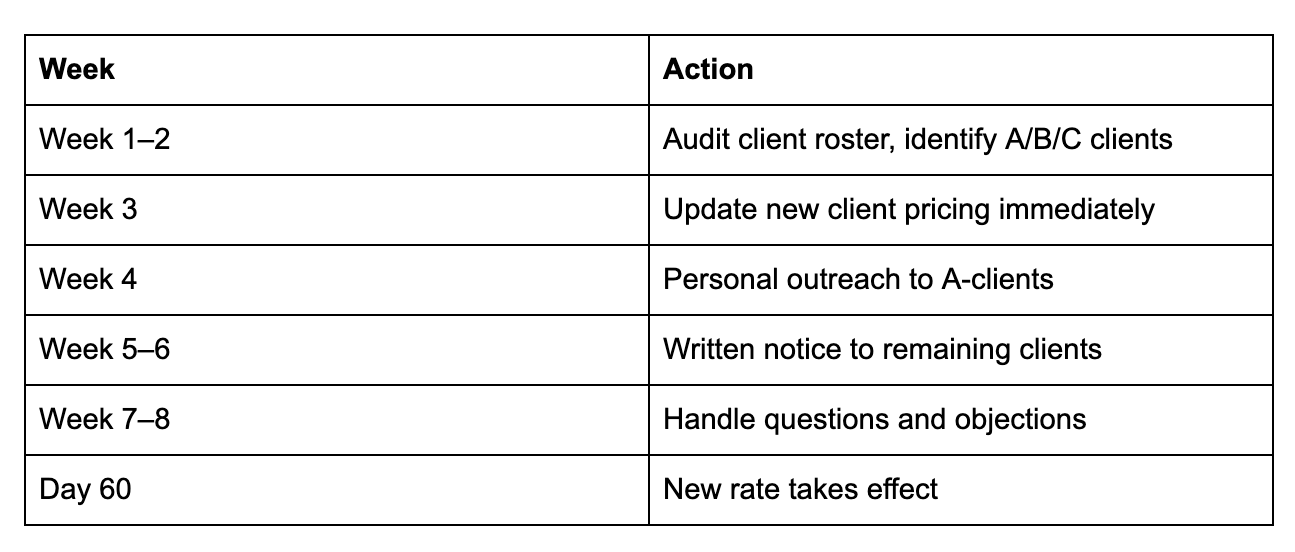
2️⃣ The 60-day rollout looks like this:
The Objections You'll Hear (and How to Handle Them)
"Your competitor is cheaper."
➡️ "That may be true. Here's why clients choose to work with me..." Then stop talking. Let them decide.
"This is a tough time financially for us."
➡️ "I understand. One option is we revisit scope to find the right fit. What's most important to you right now?" This surfaces whether they see value or just see cost.
"Can we lock in the current rate for another year?"
➡️ This is the negotiation move. If you agree to this, you've trained them that negotiating works. Either hold the rate or offer a legitimate transition bridge (see Step 5 above).
✳️ The clients who walk without a conversation are the ones who were never deeply invested in your work. Their departure is information, not failure.
What This Has to Do With Your Business Maturity
Pricing is a leadership decision, not a market decision.
I've coached 150+ business owners over the last six years. The ones who stay underpriced have one thing in common. They're operating from fear of losing clients rather than confidence in the value they deliver.
That's not a pricing problem. That's a leadership problem.
When I ran my wireless retail business, we raised service fees twice in three years. Both times, we expected pushback. Both times, our client retention was higher than 90% on existing accounts. Both times, our revenue per account went up and our support complexity went down.
The clients who value what you do will pay for what you do. Full stop.
✳️ The 7th Core Competency: Innovation and Technology; isn't just about software. It includes innovating your own business model. Your pricing is part of that model. If it hasn't changed since you started, it's outdated.
Your Pricing Health Check
Ask yourself these questions right now:
✅ Have I raised prices in the last 18 months?
✅ Do my current rates reflect my current skill level?
❌ Am I discounting to keep clients who aren't a great fit?
❌ Am I subsidizing difficult clients at the expense of my team?
❌ Have I hired people, added overhead, and improved my service without adjusting what I charge?
❌ Do I secretly think my clients would leave if I charged what I'm actually worth?
If your ✅ list is short and your ❌ list is long, you already know what to do.
🎯 The Coaching Corner
For coaches, consultants, and fractional leaders building their own practices.
Everything in this issue applies directly to your business. But there's an additional layer.
Your pricing signals your position in the market. When business owners evaluate a coach, they often read your rates as a proxy for your quality. A coach at $500/month doesn't occupy the same mental category as a coach at $2,000/month, even if the delivery is identical.
For coaches in the Hustler or Operator phase of building your practice ($100K–$500K), a price increase does two things:
1️⃣ It increases your revenue per client so you can serve fewer clients at a higher impact.
2️⃣ It positions you differently in your market, which filters for clients who take the work seriously.
The coaches I work with who charge premium rates consistently report the same thing: higher-priced clients are more committed, more coachable, and generate better results. That's not a coincidence. People invest more attention in things they've invested more money in.
➡️ Use the same math. Use the same communication framework. And recognize that your hesitation to raise your rates is the exact same fear your clients feel. Walking through it yourself makes you a better coach on this topic.
Your clients are watching how you run your own business. Model the behavior you're asking them to adopt.
To Your Success,
Eric T. Whitmoyer, Business Growth Strategist
Founder & CEO at MyBizCoaches.com
Host of The Biz Coach Show
From Startup to Exit, We're There for Your Biggest Decisions
P.S. If you're serious about taking your business to the next level, then it's time to stop figuring it out alone. The Biz Mastery Network was built for owners who want structure, strategy, and real execution support without the noise. It includes The Biz Coach Insider Newsletter, designed specifically for busy business owners who need clarity fast and results faster.
Because the difference between ordinary and extraordinary isn't luck; it's the information you act on.
Consider becoming a Certified My Biz Coach – Learn More HERE.

Get In Touch
Email: [email protected]
Address
Office: 2622 E. Palm Beach Rd.
Assistance Hours
Monday to Saturday - 9:00am to 8:00pm
Sunday - CLOSED
Phone Number:
(623) 294-3795
Empowered Growth With Coaching
Trusted by owners who scaled past $10M and beyond.
© 2026 - All Rights Reserved