Biz Coach Insider+ - Fifty-Fourth Edition
I came across a newsletter from Ryan Serhant this week and it stuck with me: "Winter Is Coming. Here's How I'm Preparing for It." (Nov 7, 2026).
I'm not a real estate specialist. But my wife has worked in and around the real estate industry for 20 years, and between my own investing, her clients' experiences, and the business owners I work with on Main Street USA, I've seen a few cycles play out. Ryan's message lines up closely with what I'm seeing.
The Pressure Is Changing
Ryan points to a few signals worth paying attention to. I checked each one against the source:
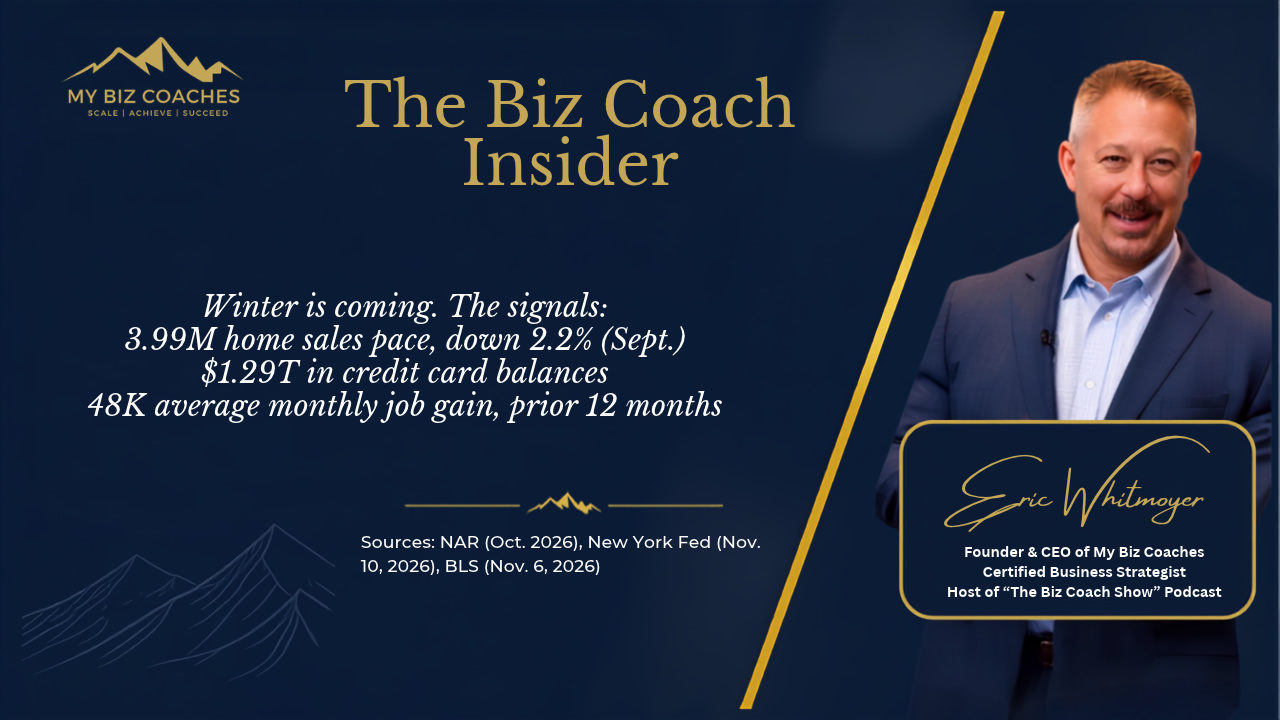
✳️ Housing is slowing. Existing-home sales ran at a seasonally adjusted annual rate of 3.99 million in September, down 2.2% from a year earlier. NAR's chief economist said August and September were the two slowest months of the year (NAR, Oct 2026).
✳️ Consumers have a thinner cushion. Credit card balances reached about $1.29 trillion in the third quarter, and 6.87% of card balances moved into serious delinquency (New York Fed, Nov 10, 2026).
✳️ The jobs trend is weaker than the headline. October added 165,000 jobs, but the average monthly gain over the prior 12 months was only 48,000 (BLS, Nov 6, 2026). As Ryan puts it, one month is weather and the trend is climate.
✳️ AI spending is huge. The four largest tech companies are on track to spend more than $725 billion on AI buildout this year (Financial Times tally, May 2026), and later estimates run higher. That money will create big winners, and it will also leave some companies stuck with costs that don't pay off.
Here's why this matters beyond real estate. Real estate activity has historically been one of the earliest signs of where the broader economy is going. Every home sale feeds agents, lenders, title companies, inspectors, contractors, movers, insurers, furniture stores, and the restaurants and service businesses those people spend money with. When transactions slow, Main Street feels it next. If we're feeling it in real estate now, the broader economy may not have felt the full impact yet.
I'm not predicting a recession. Nobody knows the timing. But I agree with Ryan: you don't wait for the storm to get the house ready.
Topic 1 | Competency Tactic: How to Prepare With the 7 Core Competencies
Slow markets expose weak spots fast. Here's where I'd focus, starting with the one most owners skip:
1️⃣ Operational Excellence: Tighten systems and eliminate waste. Inefficiency hides when volume is high and shows up fast when it drops.
2️⃣ Leadership & Vision: Set a clear 12-month plan for a harder market, not the market you hope for. Your team and clients take their cues from you.
3️⃣ Financial Acumen: Know your numbers cold. Build 6 months of operating reserves, cut costs that don't produce revenue, and stress-test what happens if revenue drops 20%.
4️⃣ Sales & Marketing: Pipeline is oxygen. Stay in front of past clients and referral partners now, before your competitors pull back and then come back scrambling.
5️⃣ People Management: Keep your best people and invest in them. In tough markets, top talent goes to the companies that look prepared.
6️⃣ Client Focus: In easy markets people hire convenience. In hard markets they hire expertise. Be the advisor your clients can't make a decision without.
7️⃣ Innovation & Technology: Use AI and automation now, while you have time to learn it, not later when you're forced to. Put the time you save back into relationships.
➡️ This week: pick the one competency where a 20% revenue drop would hurt you most, and write the first fix on one page.
Topic 2 | Phase Insight: Know Which Phase You're In
My 8 Phases of Scale framework has one simple rule for a slowdown: strengthen the phase you're in before you push to the next one.
Owners who scale past their foundations in a downturn are the ones who get hurt. Owners who tighten their systems, margins and team now are the ones positioned to take market share when things turn, and their businesses will be worth more if they ever plan to sell.
This hits hardest in the Architect phase ($1M to $3M). That's where owners are tempted to add a location, a product line or a layer of managers on the strength of last year's numbers. In a slowing market, the better move is to make sure your systems scale before your headcount does.
If you're in the Operator phase ($250K to $500K) or the Leader phase ($500K to $1M), the same rule applies at a smaller size: get the business running without you in the middle of every decision before you chase the next band.
➡️ This week: write down your phase and one foundation you'll strengthen before you push for growth in 2027.
Topic 3 | Playbook Deep Cut: Then Comes Spring
Ryan started in real estate in 2008 and launched his own company in 2020. Some of the best opportunities come when everyone else is uncomfortable.
Opportunity doesn't disappear in a downturn. It changes hands, from people who were comfortable to people who were prepared.
That idea runs all the way through The CEO's Playbook for Scale: the businesses that grow through a hard market are the ones that built the foundations in the good one. Preparation is a leadership decision you make before anyone else thinks you need to.
We can't control the economy. We can control how ready we are for it.
➡️ This week: list three things you'd do if a competitor pulled back in Q1. Then decide which one you can start now.
Coaching Corner: If You're in Your 50s and Facing a Transition
This is the part I feel most strongly about.
Many people in their mid-50s are facing layoffs, buyouts or downsizing right now, and finding a comparable job at this stage is harder than it should be. In October, unemployed workers aged 55 to 64 had been looking for an average of 34.1 weeks, versus 28.1 weeks across all ages (AARP, using BLS data, Nov 6, 2026).
Many are deciding to start or buy a business instead. That can be a great move if you go in with your eyes open:
✅ Don't drain your retirement to fund an idea. Validate first. Get paying customers before you make big investments.
✅ Consider buying instead of starting. About 2.9 million U.S. businesses are owned by people aged 55 or older (Project Equity, 2026), and many of those owners want to retire. An established business with cash flow is often less risky than starting from zero.
✅ Turn your experience into income. Consulting, fractional executive work and coaching let you earn from what you already know, with low startup costs.
✅ Keep bridge income. Part-time or contract work while you build buys you time and lowers the pressure.
✅ Get a plan and a sounding board. The biggest mistakes I see in this stage come from making decisions alone and in a hurry.
Before You Go
Which of these would hurt most if 2027 gets harder: your reserves, your pipeline, or your plan?
If you'd like help building your plan for the next 12 months, reply to this email and we'll set up a time to talk.
And if you're a Broker or Team Lead, I'm running 2-hour Business Planning and Goal-Setting Workshops for agents, and I'd be glad to bring one to your office.
Not sure where to start? My Biz Navigator is free, takes about 5 minutes, and shows you which of the 7 Core Competencies needs attention first: MyBizNavigator.com
General information, not financial or legal advice.
Sincerely,
Eric T. Whitmoyer, Business Growth Strategist
Founder & CEO at MyBizCoaches.com
Host of The Biz Coach Show
From Startup to Exit, We're There for Your Biggest Decisions
P.S. Curious where your business really stands? My Biz Navigator is a free 5-minute assessment that shows you exactly what's working and what it's quietly costing you.
Take it here → www.MyBizNavigator.com
Because the difference between ordinary and extraordinary isn't luck; it's the information you act on.